How to Keep a Garden Journal You'll Actually Stick With
Brian Eden
When we added our new raised beds last year, I invested in a lavender journal to keep track of everything. It had a ribbon bookmark, which tells you something about the optimism involved.
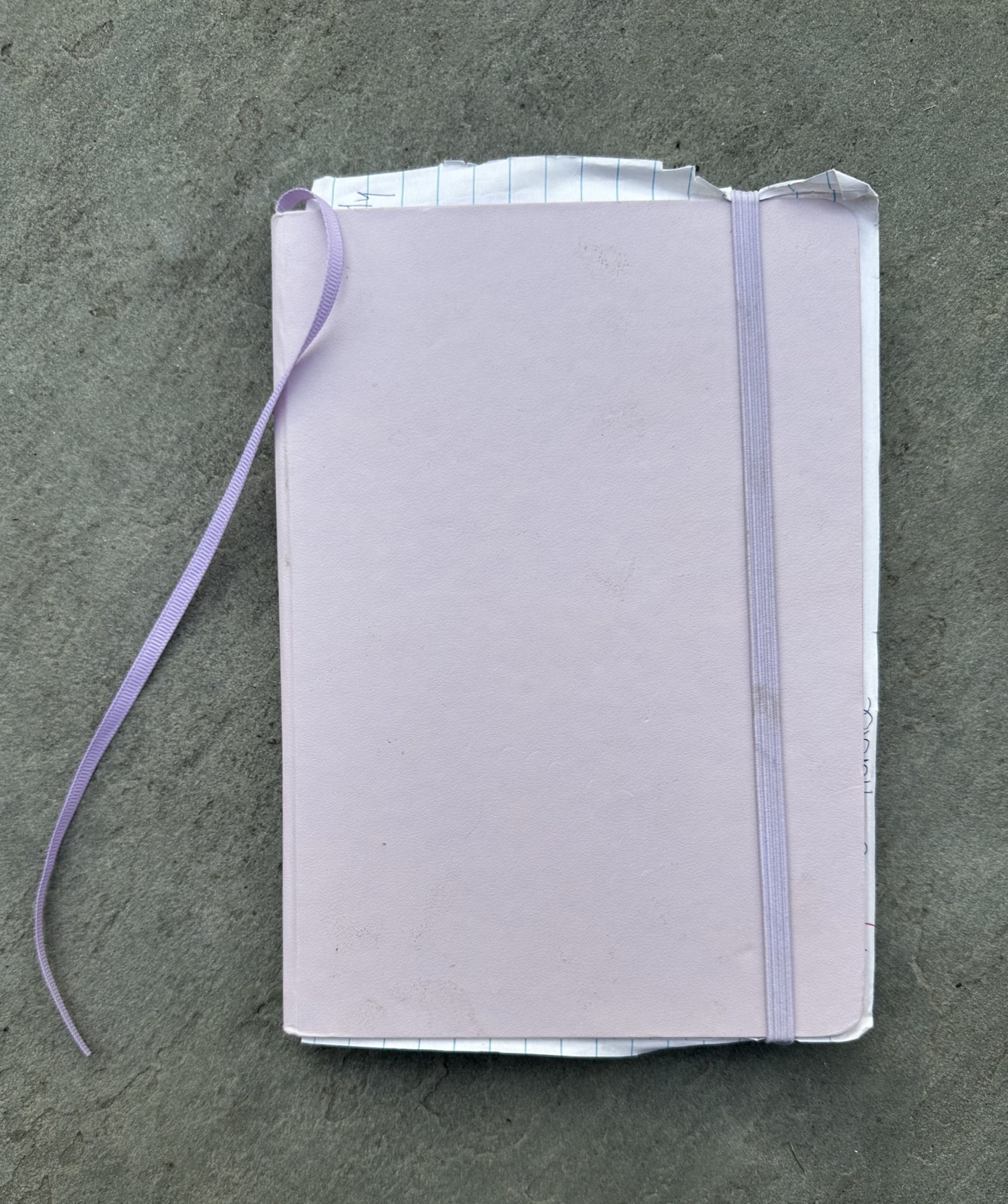
Our new beds were a clean slate. A new garden would mean a new (suddenly organized) gardener. There would be no more stray notes about slugs and fertilizer in my phone sandwiched between the ones that said "plumber saturday" and "bananas?"
I had romantic visions of a well-worn journal filled with poignant observations about growing patterns and elegant botanical sketches in the margins.
(I don't sketch, but I had to be prepared for all the ways this journal might improve things).
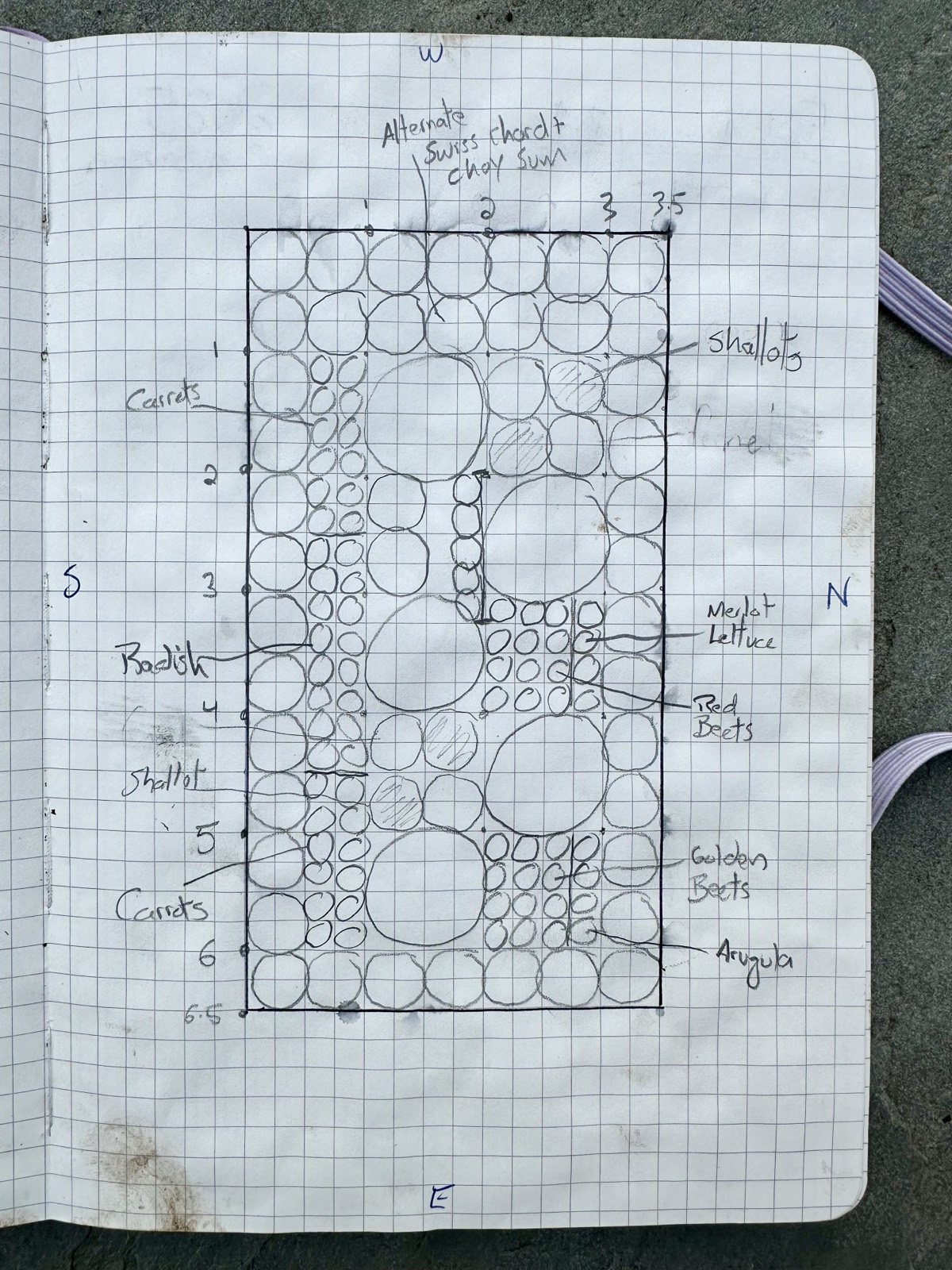
The season started strong. I bought a ruler (no I didn't own a ruler and yes I bought it specifically for this). Then I drew a spring planting grid so carefully that it's measured in quarter-foot increments. I drew a circle for each plant to represent its spacing at maturity. Shallots in the upper right. Merlot lettuce in the middle. I included a "North" arrow in case I forgot which way north was, despite the fact that I live here. It is objectively a beautiful planning document.
Then summer came.
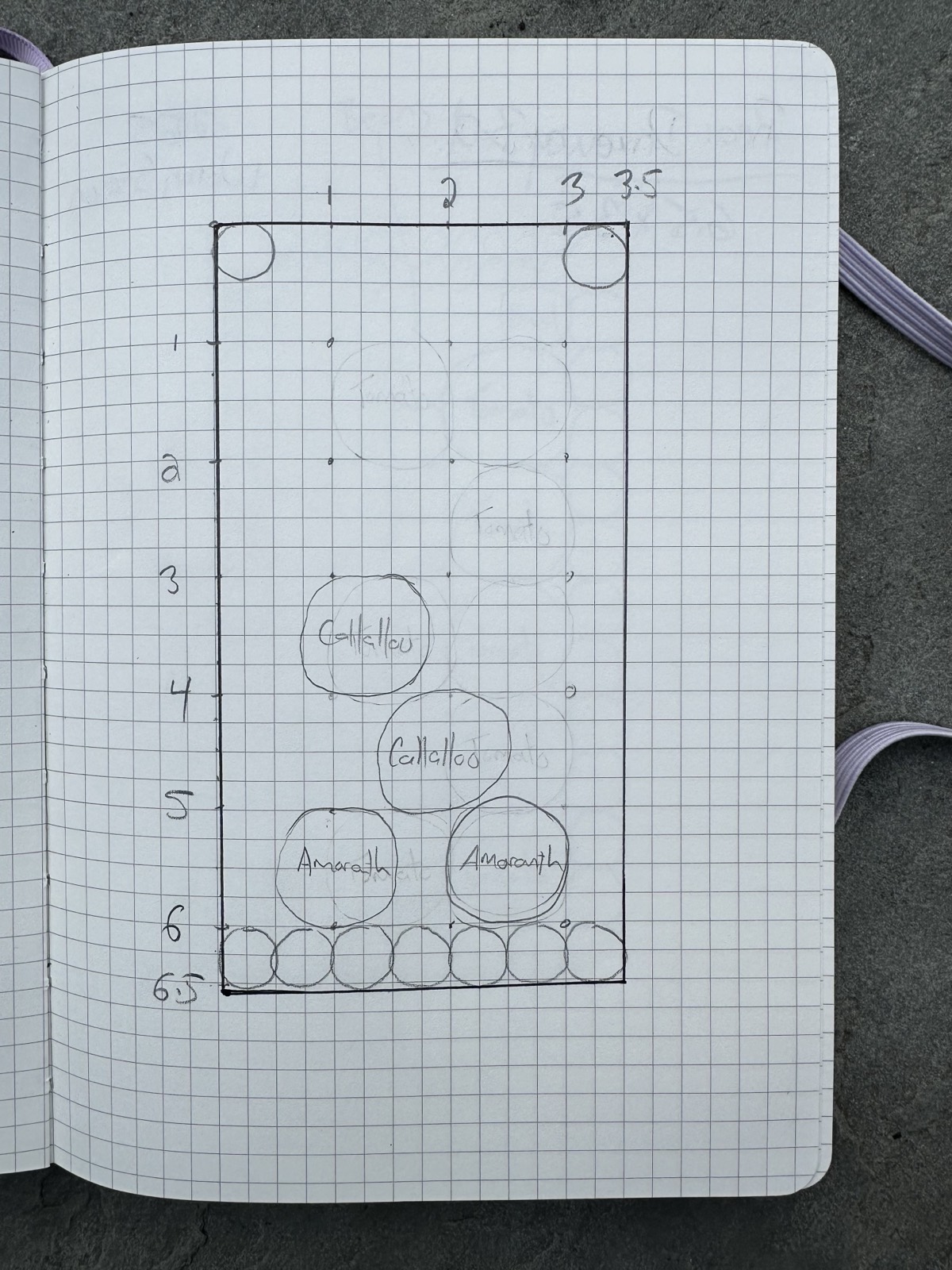
My summer garden page got the same careful ruler and ink treatment, but only four circles, (two Chinese Amaranth, two Callaloo), a row of mystery plants that would grow to a half square foot at maturity, four erased circles that still have a faint mark where tomatoes may or may not have been planted, and a lot of white space that I apparently decided to save for later. Plants did go in those spaces in my actual summer garden, but the journal version will forever be barren.
By the end of the growing season, I was sure this journal would hold dozens of priceless lessons learned tending my new beds. Careful notes about what worked and what didn't. The things I should take forward with me into the next year as key learnings. A lavender ribbon to mark the key findings. It would be the physical embodiment of a well-seasoned gardener who also took up sketching.
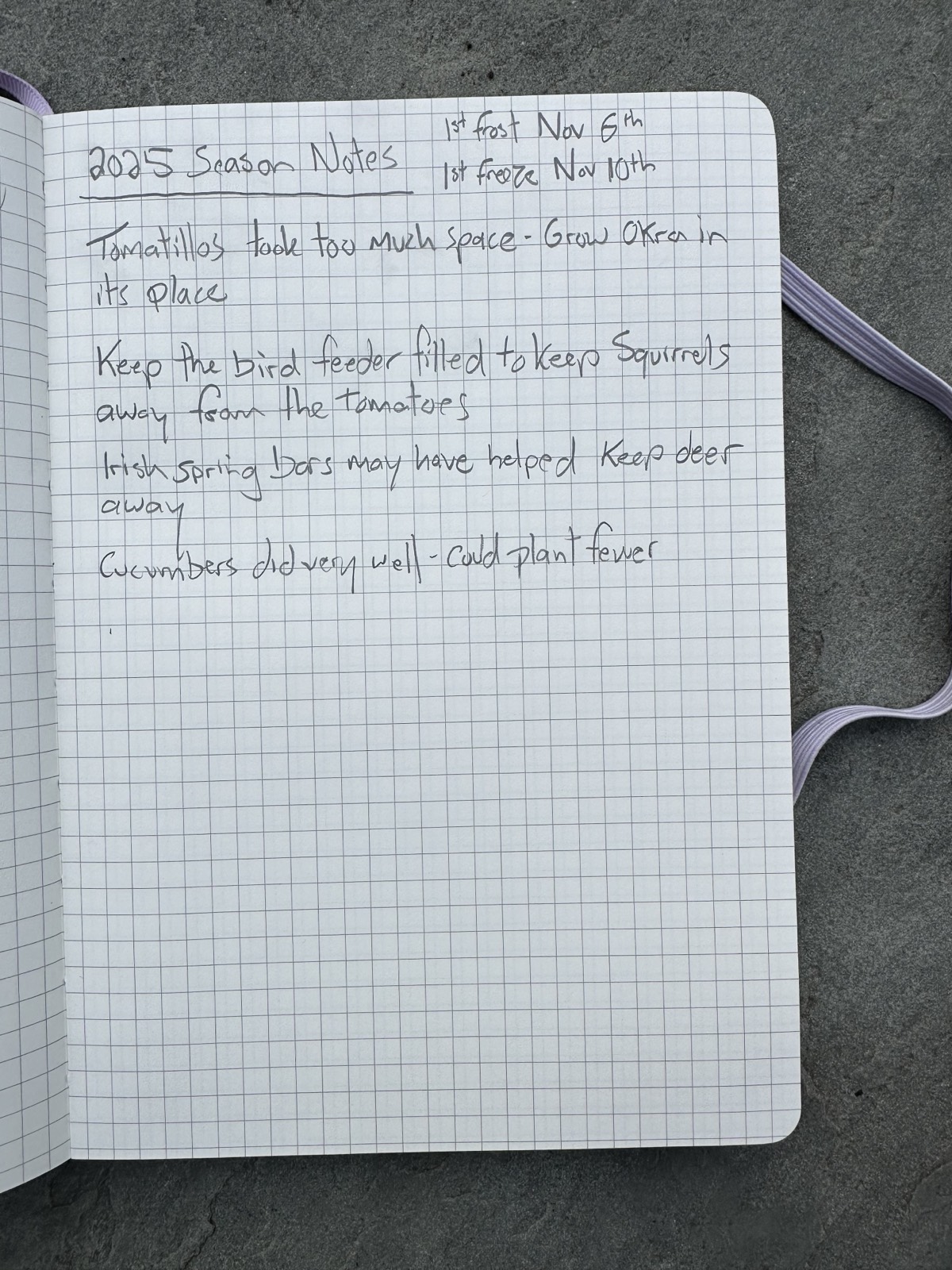
Instead, there's exactly four observations. One is a reminder to keep the bird feeder filled to help distract the squirrels from stealing all the tomatoes. Another notes, with appropriate uncertainty, that Irish Spring bars "may have helped" deter deer.
I have never once gone back and read those notes.
There are also two wayward pieces of looseleaf paper with varietal names written on them in an organizational attempt I cannot reconstruct, tucked inside the notebook and secured with the purple elastic band for safekeeping.
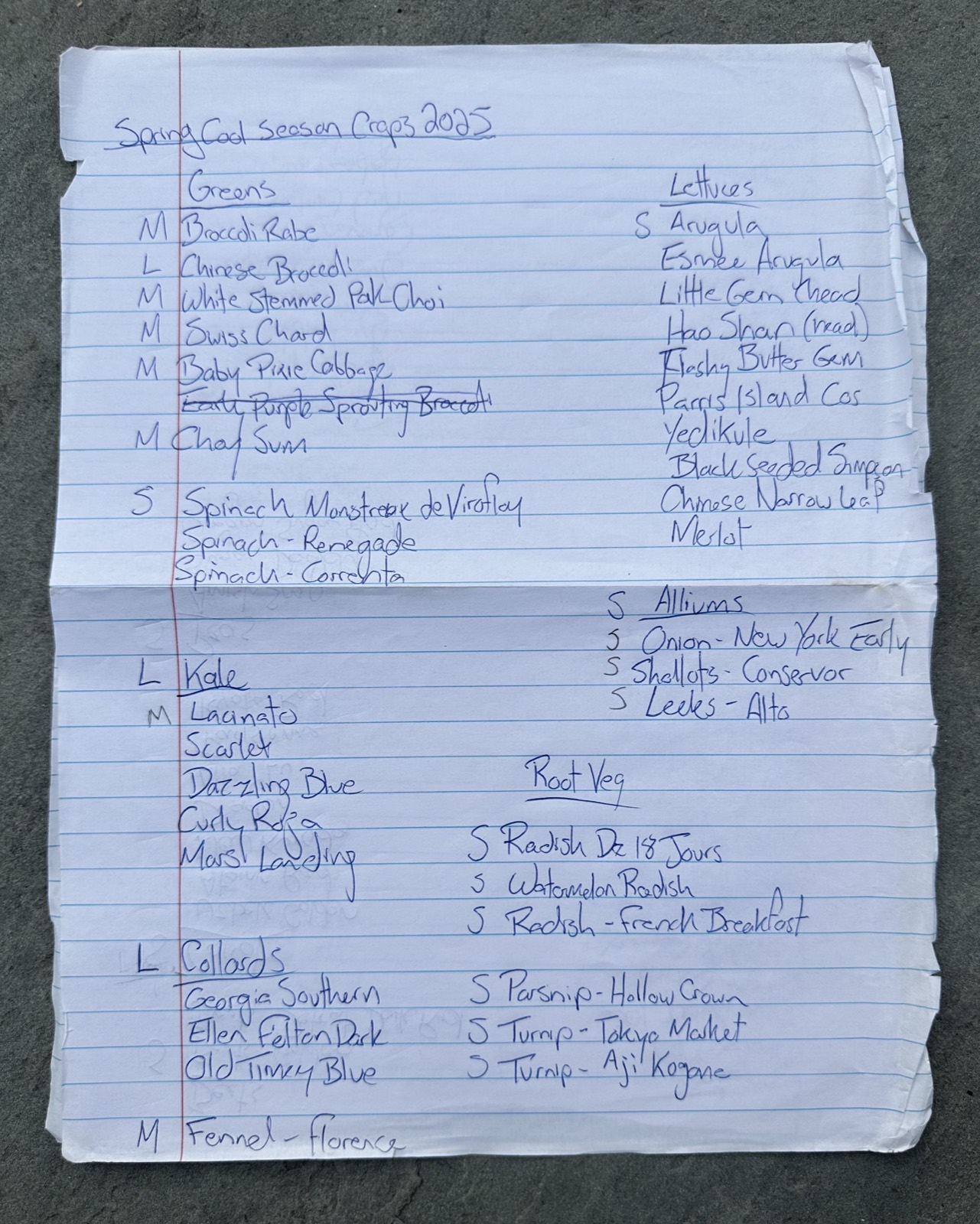
I've since lost the ruler.
This is not a cautionary tale. This is a garden journal. Many of them look exactly like this.
Why paper garden journals fail (it's not you)
As big of a flop as my foray into gardening journaling proved to be, it wasn't entirely my fault. If you've struggled to keep one, it's not yours either.
The issue is, a paper garden journal asks you to do several things at once: remember it exists, stop what you're doing, go find it, and then have something to write with. Each of those is a small obstacle. Together, they're enough to add up to four observations by year's end.
You're in the garden, hands dirty, watching the first ripe Sungold finally come in, or noticing the aphids have found the kale, or realizing the peas are two weeks ahead of where they were last year. The notebook is inside, under a stack of seed catalogs. By the time you've washed your hands and found a pen that works and wondered what those random notebook pages of plant varieties were supposed to mean, the moment's gone. You tell yourself you'll write it up later with more detail. That version never gets written either. We can barely remember which way is North.
My garden journal failing is not a discipline problem. It's a design problem. The ritual of garden journaling asks for the most effort at exactly the moment you have the least to spare — in the garden, hands dirty, trying to keep your seed packets from blowing away. The impulse was always right. The tool kept getting in the way.
What actually makes a gardening journal stick
The short answer is: no friction. A garden journal you'll keep has three qualities.
It's there when you are. The best time to record something is the second it happens, standing right there in the garden. If capturing a note takes more than a few seconds, it's not gonna happen. Especially not in July when all the good stuff you want to remember is happening all at once.
It doesn't need to be tidy. The Irish Spring note was useful. It was not beautiful. That's fine. A messy note you actually made beats a gorgeous hand-lettered entry you didn't. I'll find out this season if the Deer prefer Dove Deep Moisture.
It forgives the gaps. You will miss days. Weeks, probably. A garden journal isn't a streak to protect. It's a net. And a net with holes still catches most of what matters.
If a paper notebook gives you those three things, keep the notebook. There are some enviable gardeners with an entire bookshelf of well-worn, dog eared, plant sketch filled lavender journals.
For the rest of us, the thing that gives us all three of these things at once is something we're already carrying and can just talk to.
What's actually worth writing down
Another barrier to keeping up with a garden journal is the blank page intimidation factor. You don't want to do it wrong. Especially in something you've (prematurely) deemed a garden heirloom and may or may not have made plans about which child should inherit the journal along with all of its priceless depth of knowledge.
Here's what's actually worth capturing:
What you planted and where. Variety, source, bed, seed or transplant. This is the note you'll be desperate for in January, sitting with the seed catalogs and absolutely no memory of what that incredible cucumber was called or whether it was worth ordering again.
What you harvested. Most garden journals are full of problems and plans and nearly empty of the payoff. Write down what you picked. What you did with it. Include the feeling of smug satisfaction. A journal that ends in June is a cliffhanger.
What the weather did. Not the numbers, the story. "It was so cold in May, it stunted the basil." "Two weeks no rain, everything's stressed." This is what you'll want to see when you're trying to figure out why a year went the way it did.
What didn't work. The shady corner that you keep trying things in that, for some reason, just seems to hate plants. The variety that looked great in the catalog and awful in August. The pest you caught a week too late. We don't like to admit defeat, so this is the hardest category to write. But the most useful category to have.
The small things. The first monarch through the garden. The bunny in the lettuce you couldn't bring yourself to evict. The way the tomato vines smelled after the rain. None of this fits in a spreadsheet, and it's the part that makes a season feel like a season rather than a project you managed.
This category is the one most journals skip entirely, and the one you'll most wish you'd kept. Remember to capture the things that make it all worth it.
Why it compounds
One season of notes is useful. Three seasons is a different thing entirely.
Year one, a garden journal is a record. You planted this, it did that. Year two it's a reference. When did I plant the cucumbers last year, and did the early ones struggle? Year three it starts to become something closer to a map of your specific piece of ground: this corner is always slow to warm up, that variety always outperforms whatever you plant next to it, the tomatoes always want two more weeks than you want to give them. Decisions that used to be guesses become things you just know. Eventually you learn to plant a hammock in that shady corner instead.
That only shows up if you keep going. Which is the whole reason to bother.
Where talking to it comes in
Percy is a garden journal you use by talking. Standing in the bed, hands full of cucumbers, you say what you're looking at.
"First ripe tomato, the one by the fence, and the basil next to it is starting to bolt."
And it's saved, automatically dated, with the current weather attached and a photo if you want one. Nothing to run inside and find. Nothing to wash your hands for first. Ten seconds and you're back to it.
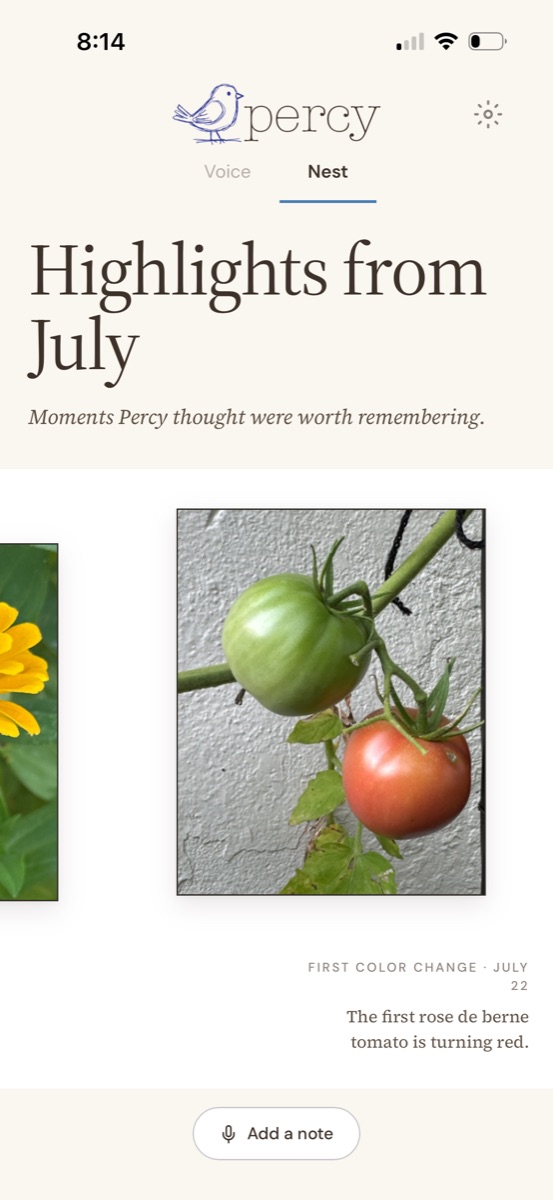
Percy keeps everything you share: the plantings, the harvests, the pest problems, the small moments, and builds it into a record of your season that you can search, revisit, and actually use. Ask it what cucumber you grew two years ago and it knows. Ask it when the aphids showed up last time and it can tell you.
At the end of the season, Percy builds you the Migration Report: the full story of your season, made from everything you gave it. Not a spreadsheet of what you grew. A record of what it was like to grow it.
Start anywhere. Whatever's happening in the garden today is a fine place.
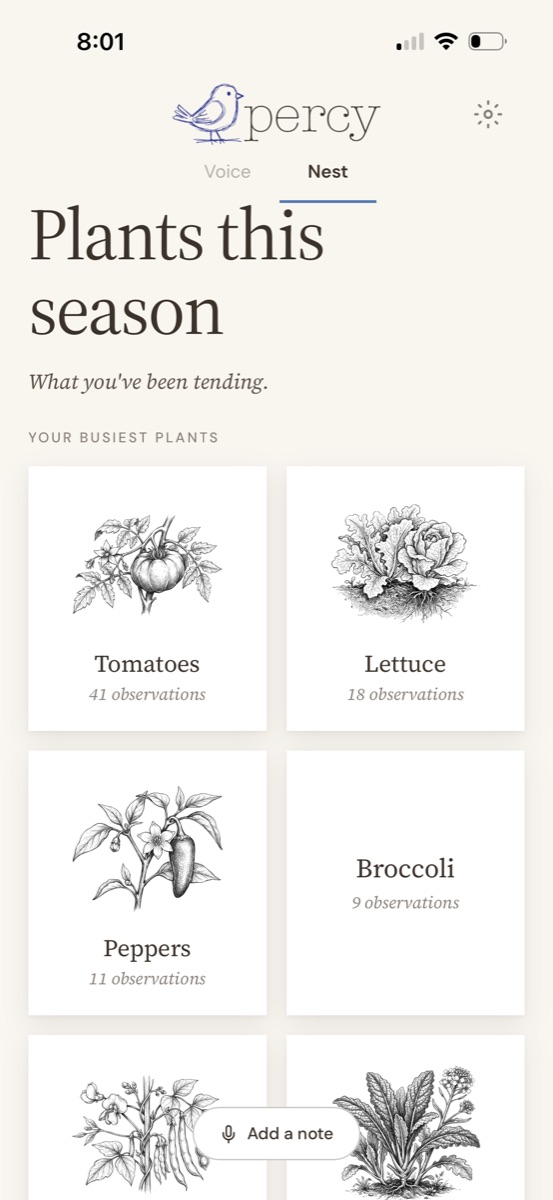
It even has sketches of your plants.
Frequently asked questions
What should I write in a garden journal? The essentials: what you planted (variety, source, location), what you harvested, what the weather did, and what didn't work. Then the small moments most people skip. Mention the first firefly, the smell after rain, the thing your kid said when she found the strawberries. Those are the ones you'll actually want back.
How do I keep a garden diary? The same way. In the UK and Australia you'll often hear "garden diary" rather than "garden journal," but it's the same idea: a running record of what you planted, what happened, and what you noticed. Everything here applies, ribbon bookmark optional.
How often should I write in a garden journal? Whenever something changes or catches your eye. There's no required cadence. A garden journal is a net for catching the season, not a streak to maintain.
Is a garden journal app better than a paper notebook? Depends on how you use it. Paper journals tend to fail because they're not nearby when the moment happens, and if they are, using them pulls you out of the moment. A garden journal app is with you in the beds. It handles the date, the weather, and the search automatically. If the notebook works for you, keep it. If you've got a drawer of lavender notebooks that didn't, it might be worth trying something else.
Do I need a garden journal template to get started? No. A template can be a useful reminder of what to record, but it can also make journaling feel like a form to fill out, which is the opposite of what you're going for. The simplest start is one note today, about one thing in your garden. It doesn't need to be meaningful. You're building the habit alongside the record, and the record can start anywhere.