10 Ways to Use Percy to Remember Your Garden
Brian Eden
Percy is the garden journal that remembers your season for you. You just talk to it. Here are 10 ways to use Percy, from logging plantings and identifying plants to getting personalized organic garden advice, setting reminders, spotting native and invasive plants where you actually garden, and building your end-of-season Migration Report.
What can you use Percy for?
Percy can:
- Keep a garden journal you talk to
- Track plantings, harvests, photos, and garden observations
- Give personalized organic gardening advice based on your garden and location
- Identify plants, pests, insects, and plant problems from photos
- Tell you which plants are native or invasive where you garden, and what they mean for wildlife
- Track weather and frost conditions
- Keep a daily weather log for your garden, including rain
- Remember garden tasks, plans, and recurring reminders
- Save garden ideas and inspiration in Someday
- Create a season-long garden record and Migration Report
How to think about it
Percy keeps track of your garden differently than most tools.
You don't have to log events, track inventory, maintain timelines or manually enter notes.
In fact, Percy doesn't ask you to manage your garden at all. You just talk about it, and Percy remembers.
Percy has three tabs:
- The Nest is your garden's past: everything you've observed, grown, and captured.
- Voice is your garden's present: where you talk to Percy about what's happening right now.
- Twigs is your garden's future: reminders, intentions, and inspiration for what comes next.

All three work the same way. You just talk.
And everything you share builds the story of your season. The plantings and the harvests, the questions, the plant IDs and the things you mean to do.
But also the things you might not think to try to remember: the morning coffees and the after-work cocktails. The mid-summer sandwich you made out of that tomato. The day your kids helped pull weeds until they got distracted by the worms roughly four seconds later. Those are the ones you'll want to remember most. They're the little things that make a season feel like a season, and they've never really had anywhere to go.
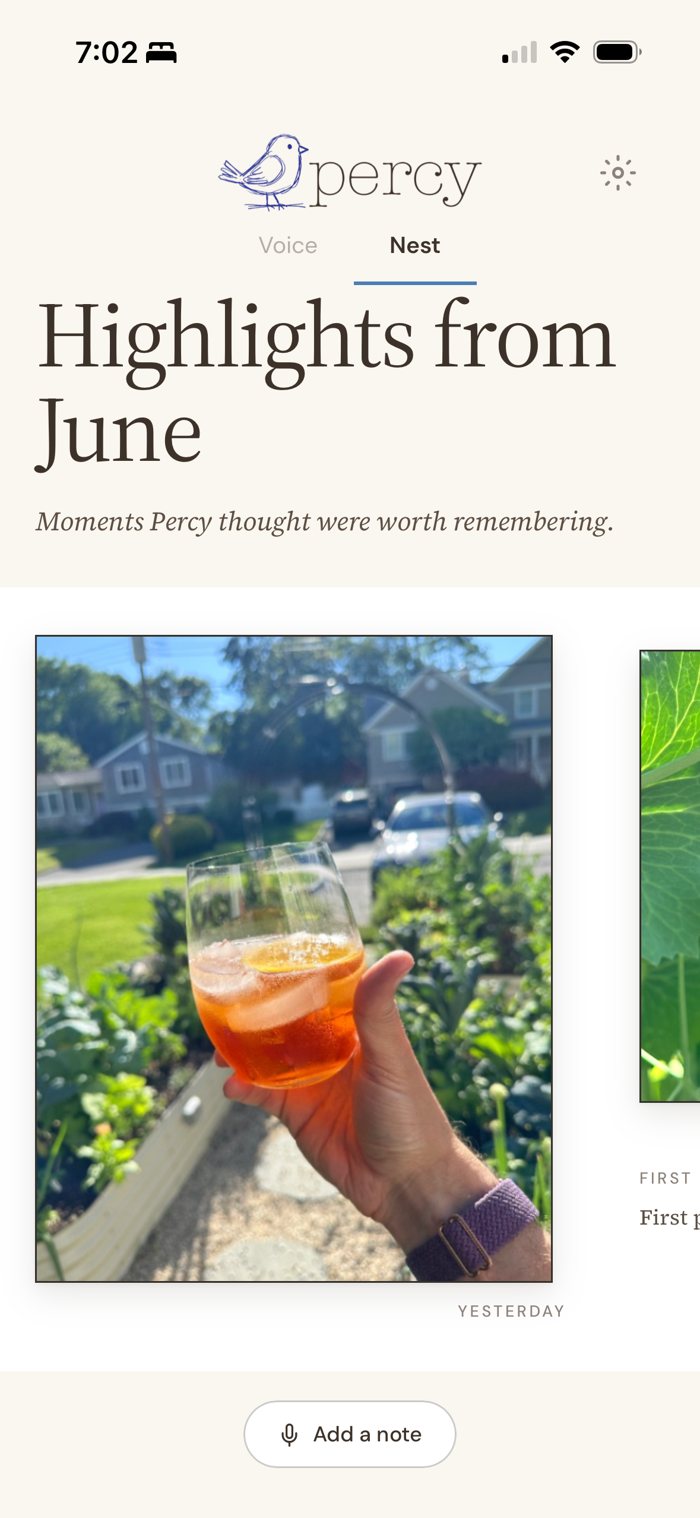
Think of it like taking vacation photos in your garden. When you look back in January, what do you actually want to remember? What did you grow? Who was there with you? What happened along the way? How did it feel?
That's Percy. You talk about whatever you notice: a planting, a harvest, a bug, a moment. Percy turns all of it into the story of your season.
Here are 10 ways to get the most out of Percy and make that story richer.
1. Log what you plant by talking
Plant something, say something. The first thing to know about Percy is that it understands plain speech. You don't need to fill out a form or scroll a drop-down menu to find your plant. Just say what you did: "I planted beans" (or something else, if you didn't plant beans). Percy handles the rest. Your plant saves automatically to the Nest, where you'll find it waiting under Plants this season, along with a small, well-earned sense of superiority for keeping a highly organized, jealousy-inducing garden record without doing any actual organizing.
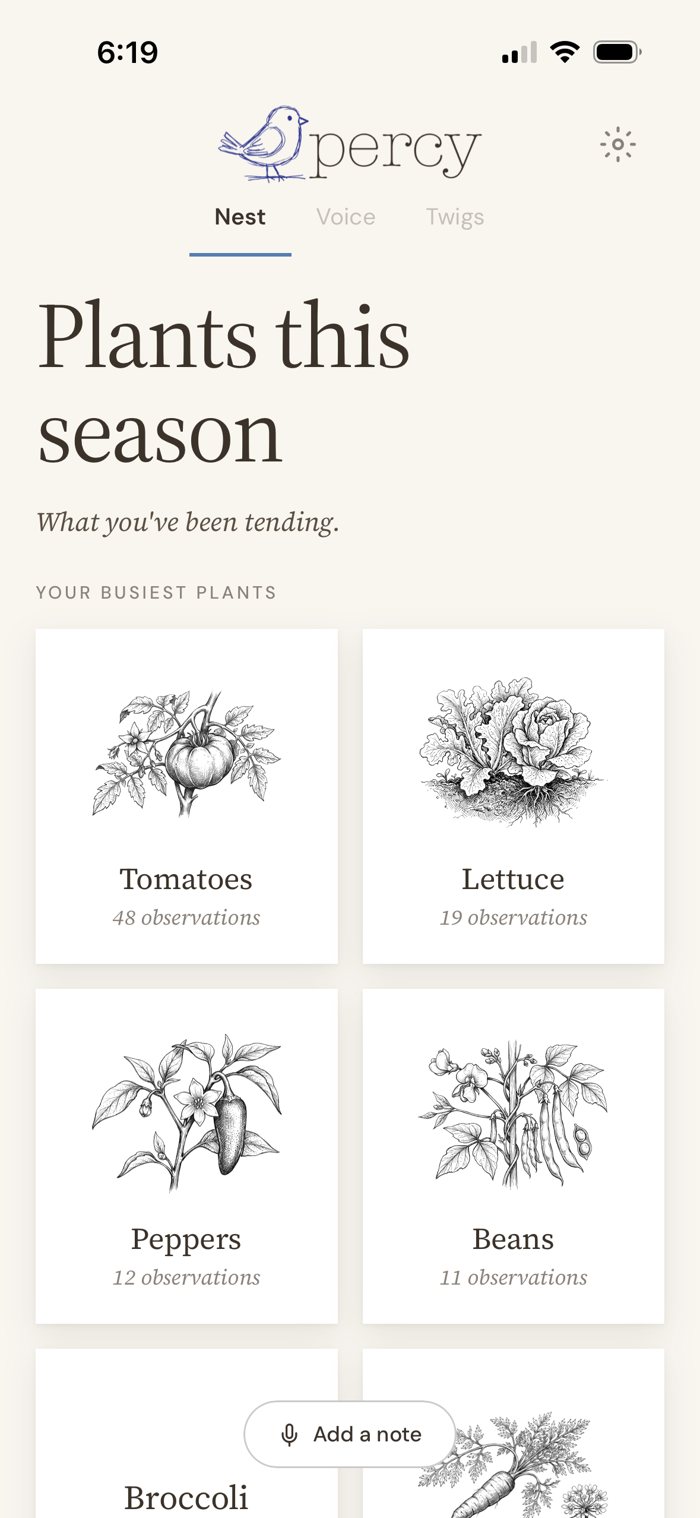
Call it whatever you want. There's no right or wrong way to make a note. Add as much or as little as you like. You can use a general name like tomatoes, peppers, or dahlias, or get specific: Brandywine tomatoes, Shishito peppers, Melodramatic dahlias. (Ok that one's not a real variety. But it should be.)
"I planted cucumbers" is a complete observation. So is "I put in six Beit Alpha cucumber transplants from the farmers market, two feet apart in the south bed, next to the trellis, and I have never been more optimistic about a cucurbit."
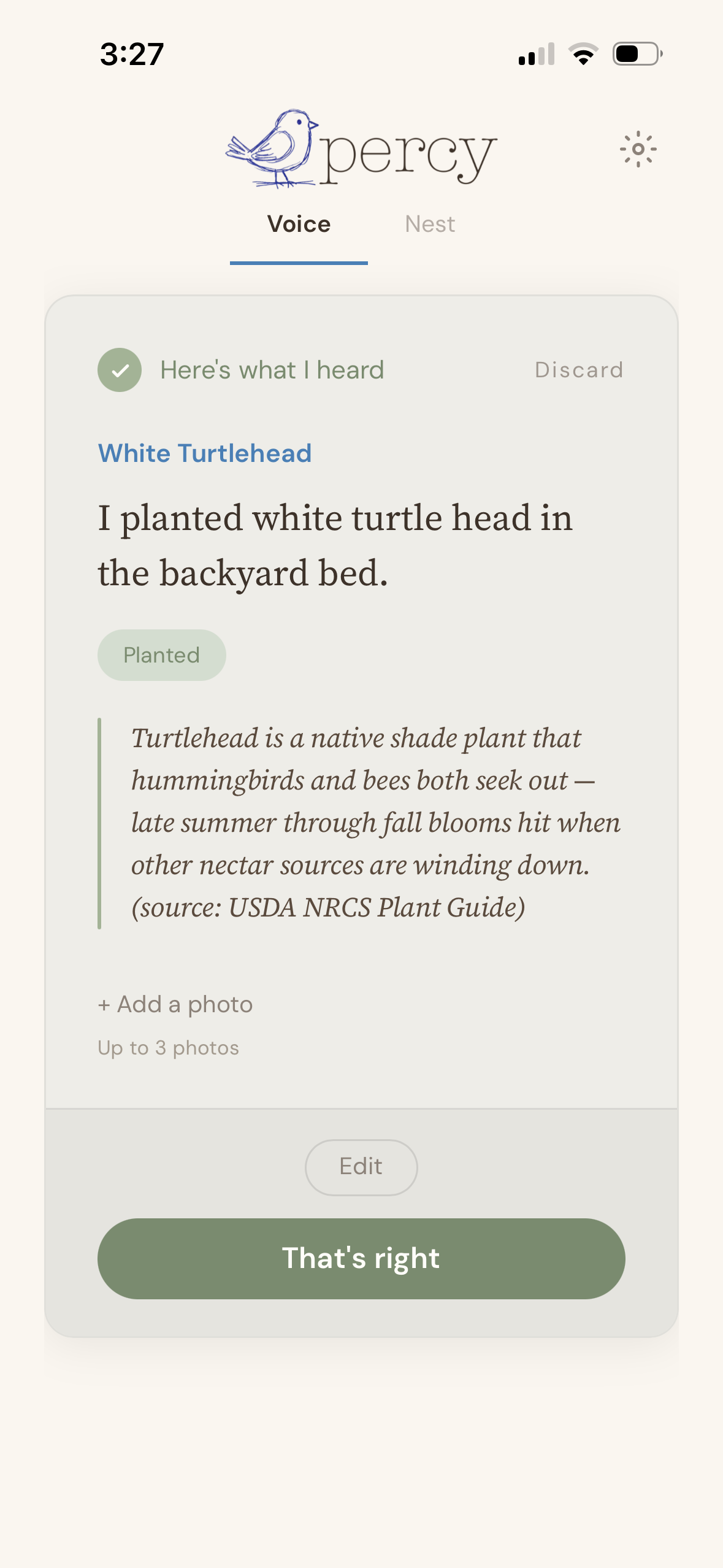
That would be a weird thing to say, but you could say it. Percy does not judge.
Add any details you might want a year from now, when you're trying to figure out why one variety did better than the others. The more you share, the more Percy has to work with, but a little goes a long way.
Each plant gets its own chapter. Every variety you mention becomes its own chapter in the Nest, with all your notes about it collected in one place. Easy to revisit. Easy to search.
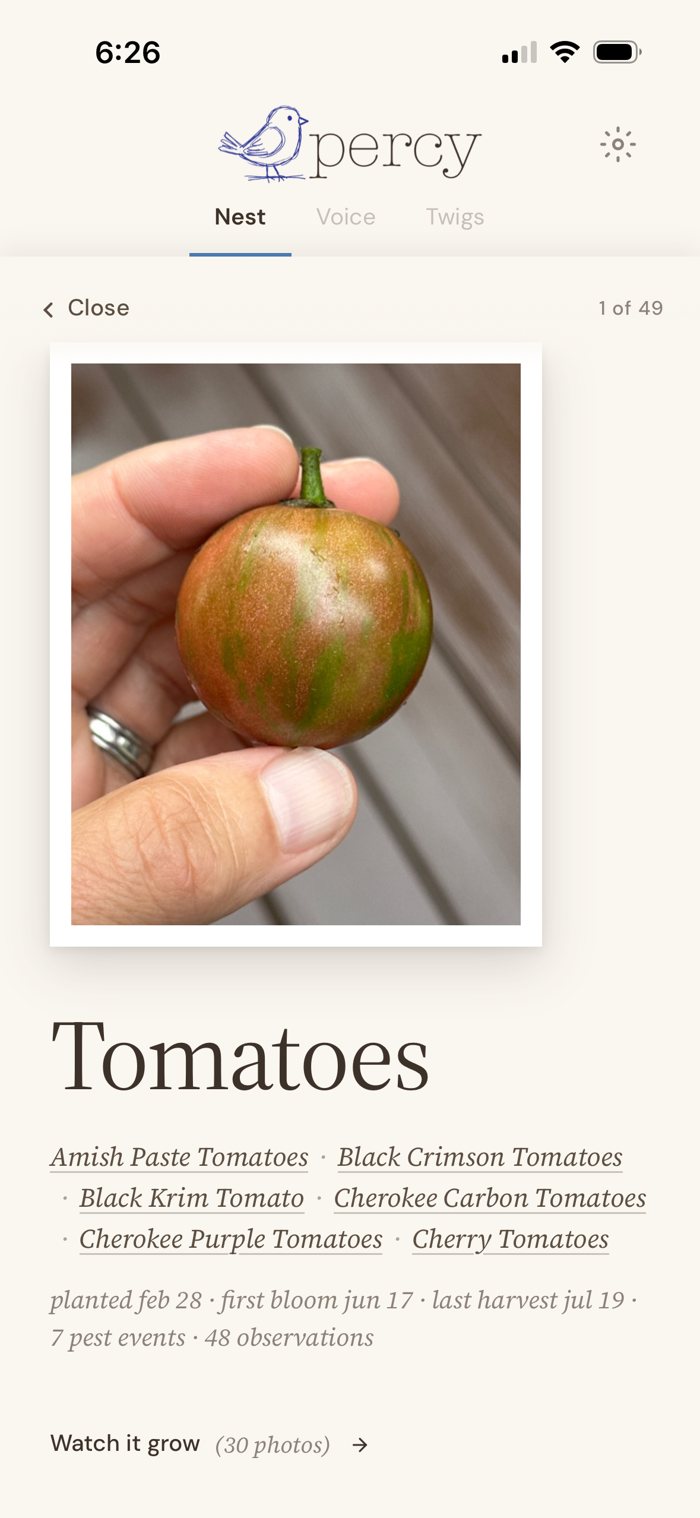
Say cheese. Add up to three photos to any observation, so you can make sure all your plants are satisfied with their headshots.
Pro tip: Take a photo of the seed packet or plant tag with your first observation. You'll want it in winter, when the seed catalogs start arriving and you have absolutely no memory of what that incredible cucumber was called, whether it's worth buying again, or whether your unbridled optimism was warranted.
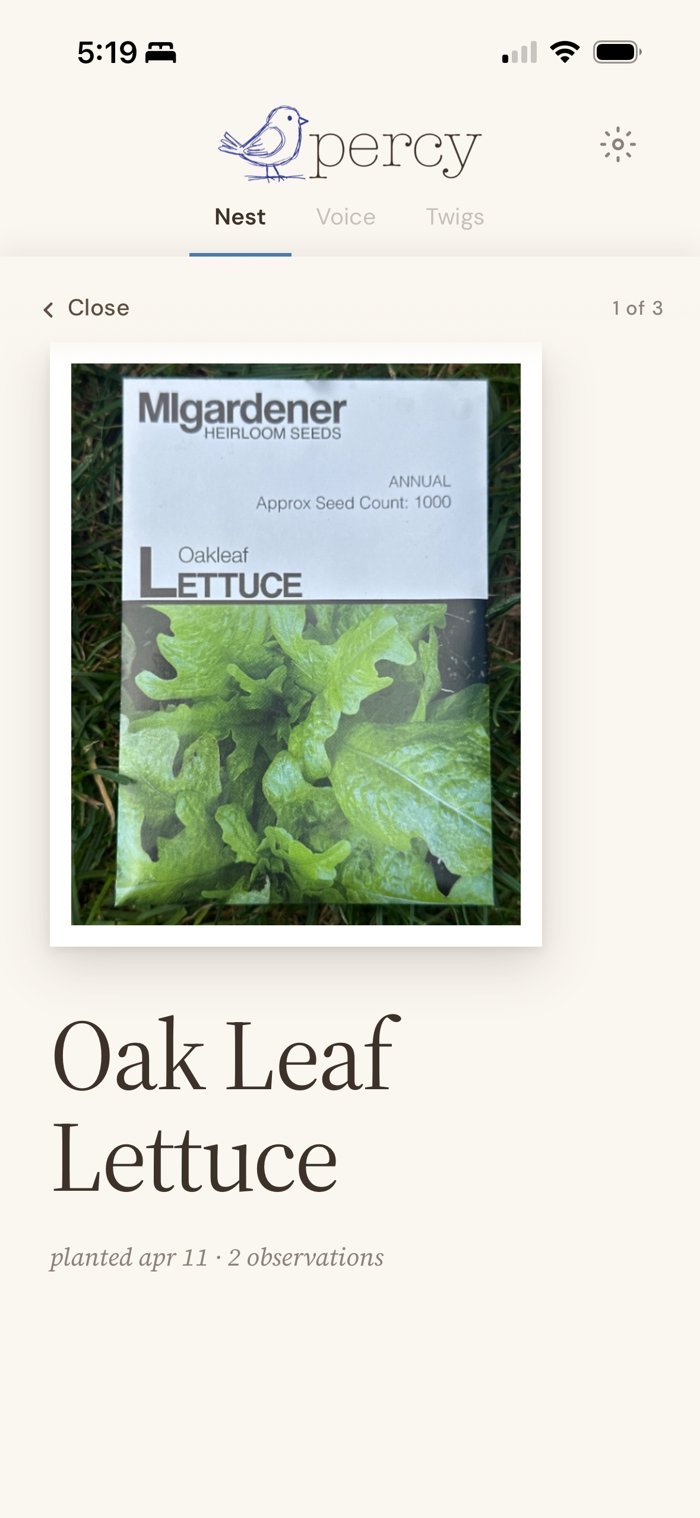
Percy keeps it all for you. The answer to "was that worth it?" is either a triumphant yes or the beginning of a very satisfying botanical grudge.
2. Track plant growth and garden progress
Hey, how's it growing? Share your garden's progress, not just the milestones. You don't have to wait for something dramatic to happen. The progress notes where nothing is wrong and nothing much is exciting are some of the most useful ones to have later.
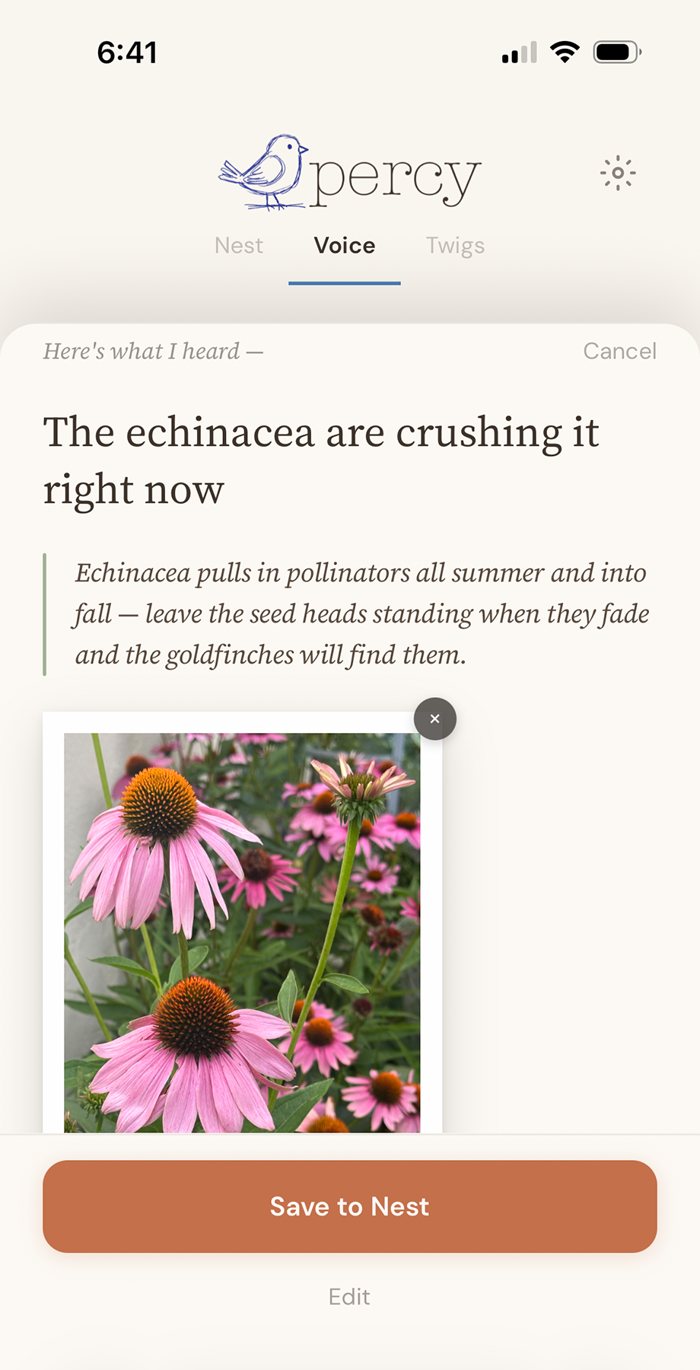
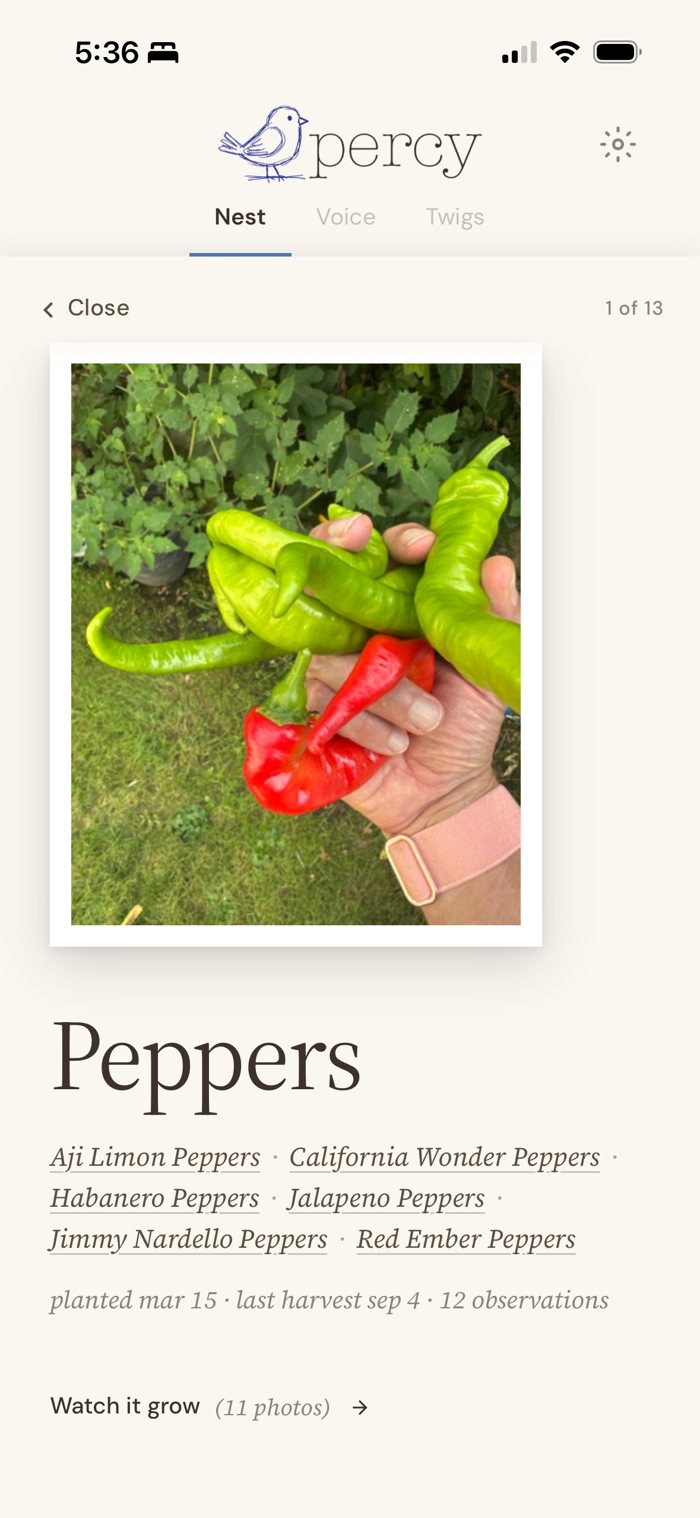
Tell Percy how things are looking this week, and take photos as your plants grow. Every plant card has a place to watch it grow, so you can swipe through the whole season: seed to seedling to sprawling, fruit-laden chaos, all in one place. They grow up so fast.
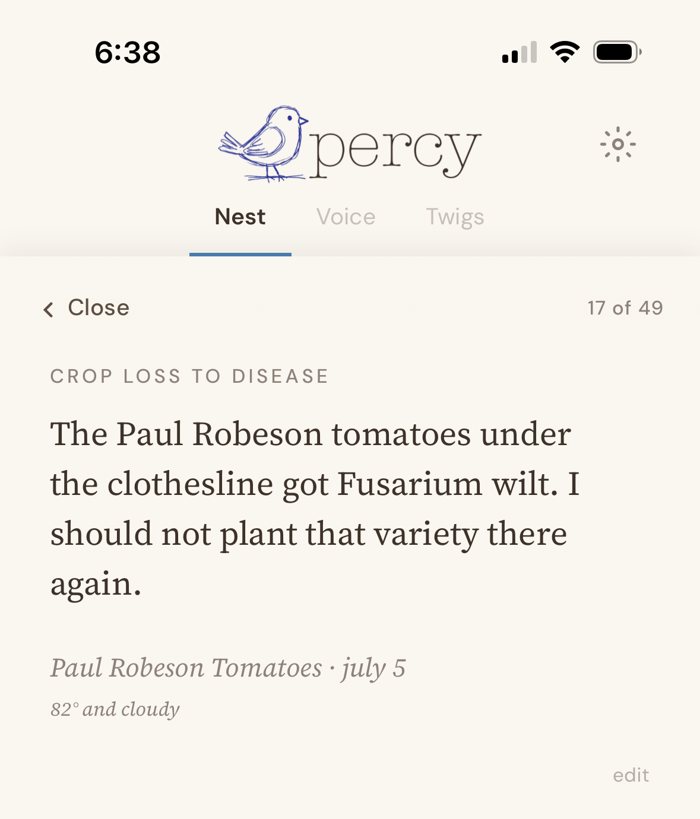
Tell Percy about the plants that don't make it, too. Every garden has them. The story of a season includes the losses, and sometimes those are the most useful notes of all.
3. Record harvests, recipes, and what you did with them
The first ripe tomato deserves its own entry. So do the peppers, and the surprise onslaught of squash. Each one is a small reminder of the hard work and patience (and occasional lack of patience) that made it all worth it.
But don't stop at the picking. Tell Percy what you did with it. Did you eat it standing in the garden before it made it inside? Cook it? Can it? Freeze it? Give half of it to a neighbor who now also has to suffer through far too much squash?
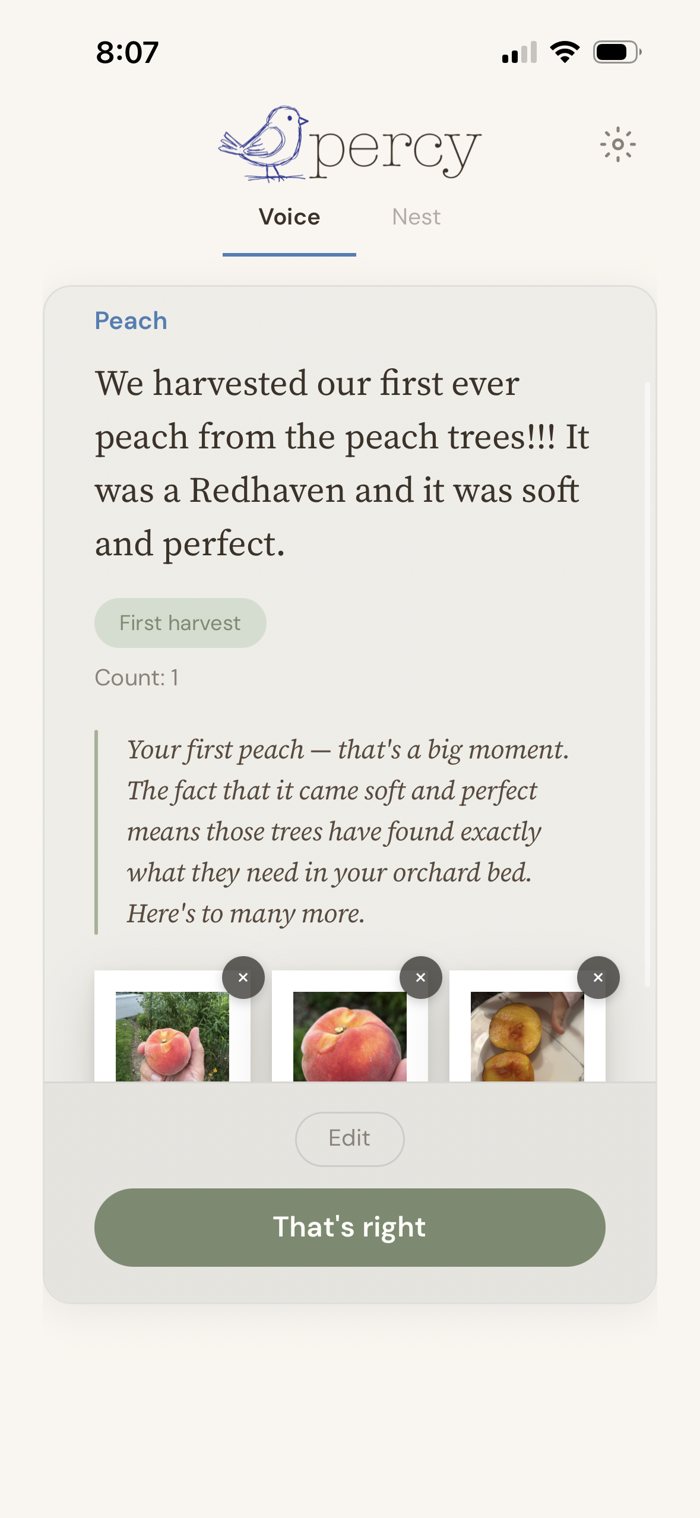
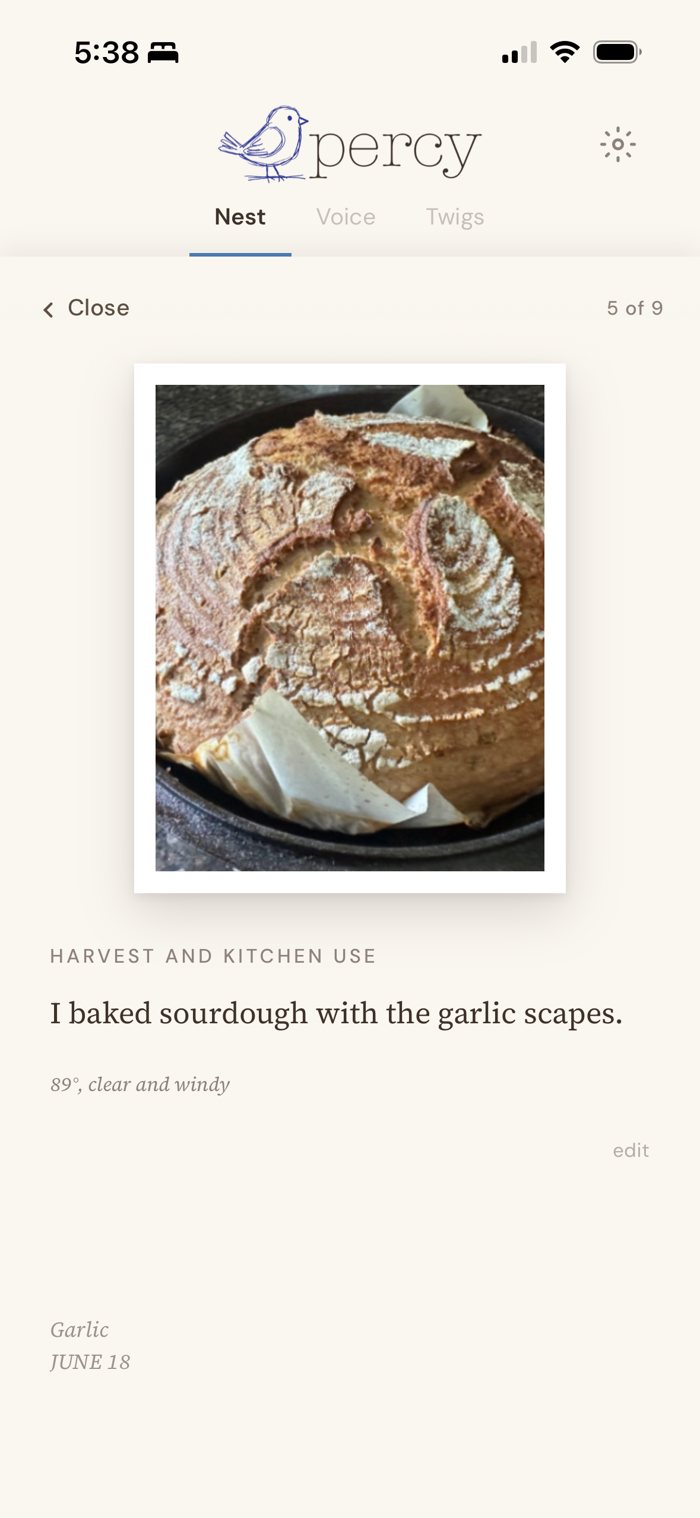
Take a photo of the thing you made. Add the recipe. Describe the neighbor's feigned appreciation for the squash and enjoy knowing, all too well, the burden they now carry. That's all part of the story of your season, and the harvests are some of the best material your Migration Report will have.
4. Get personalized gardening advice
Percy is like having a garden advisor who has been paying attention to your garden all season.
Wondering if it's too early to plant something? How much sun, space, or water something needs? Whether a particular tomato variety lacks the fundamental ambition you'd expect for your raised beds? Ask Percy.
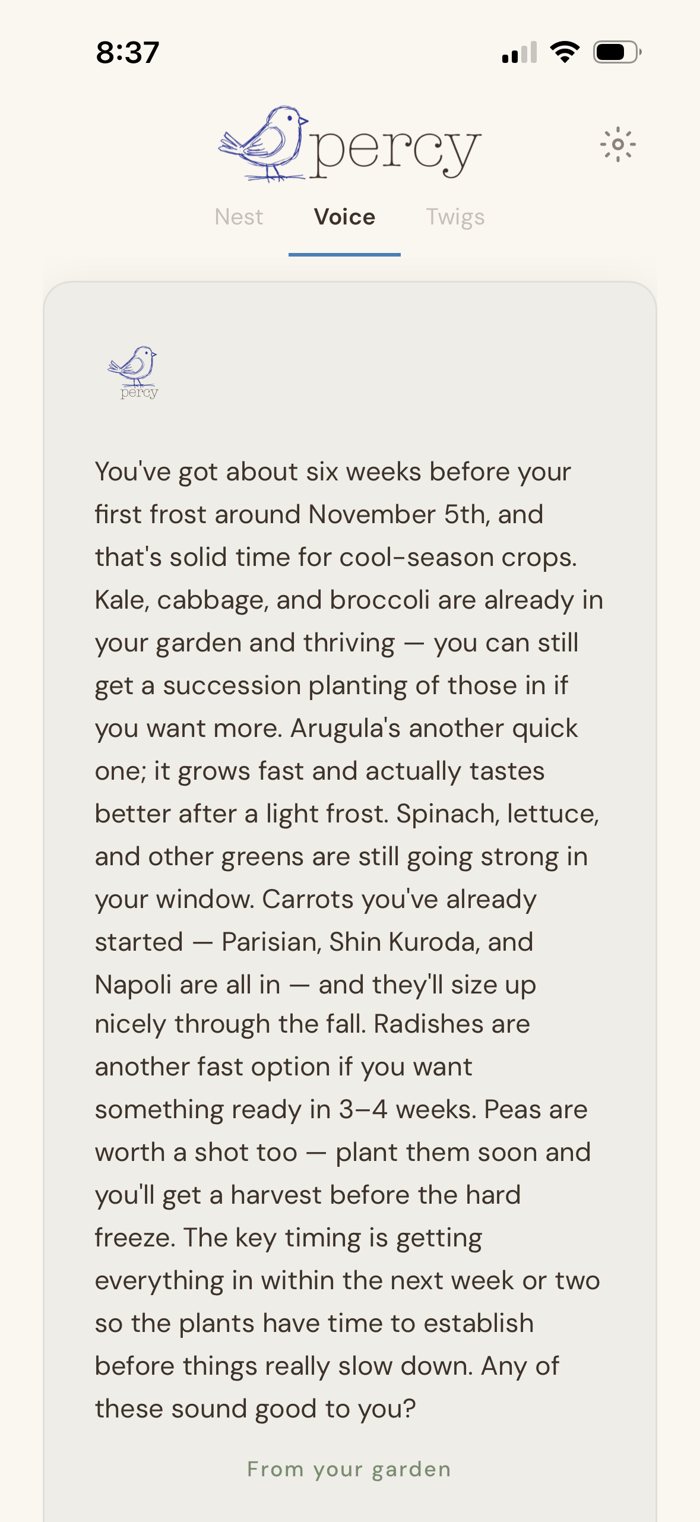
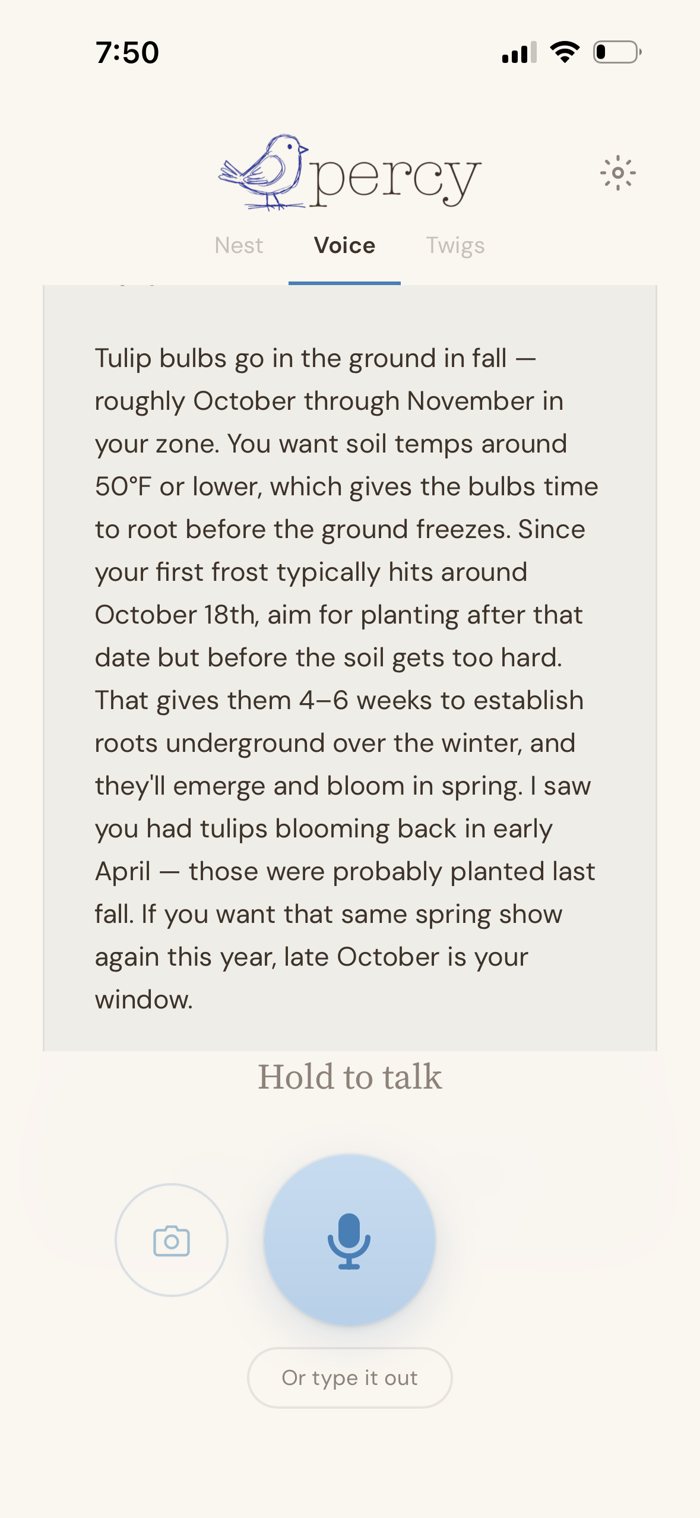
Percy answers based on everything you've already shared: your location, your plants, your beds. So you get advice for your garden. Not a stranger's zone, a stranger's soil, a stranger's tomatoes, or a stranger's much better-behaved squirrels.
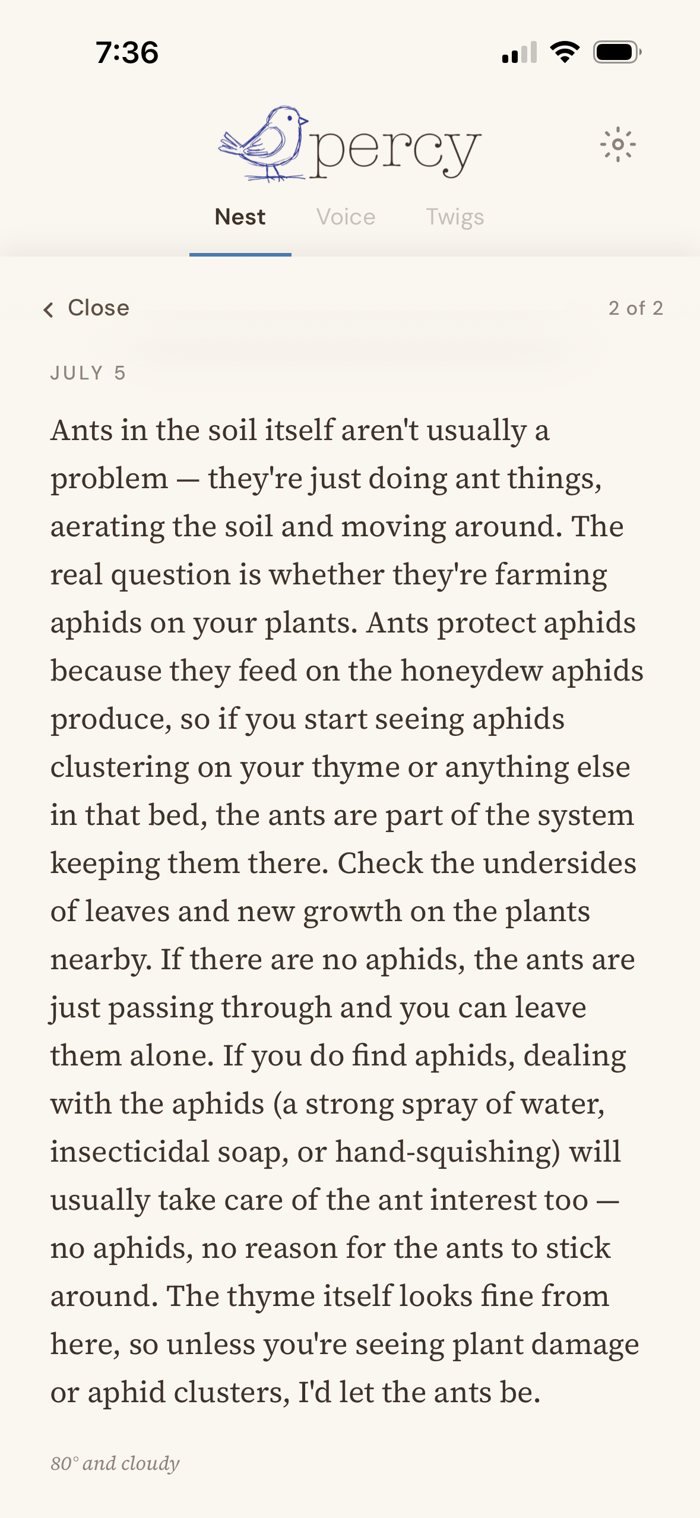
The more you share, the sharper the advice gets. And Percy doesn't always wait to be asked. Because it remembers what you've told it, later advice takes earlier problems into account instead of treating every question like a fresh start. Mention cabbage worms in June, and next season Percy may bring them up right when it matters: "This is about when the cabbage worms showed up last year. Row cover, or a lot of emergency kale salad."
5. Identify plants, pests, insects, and plant problems
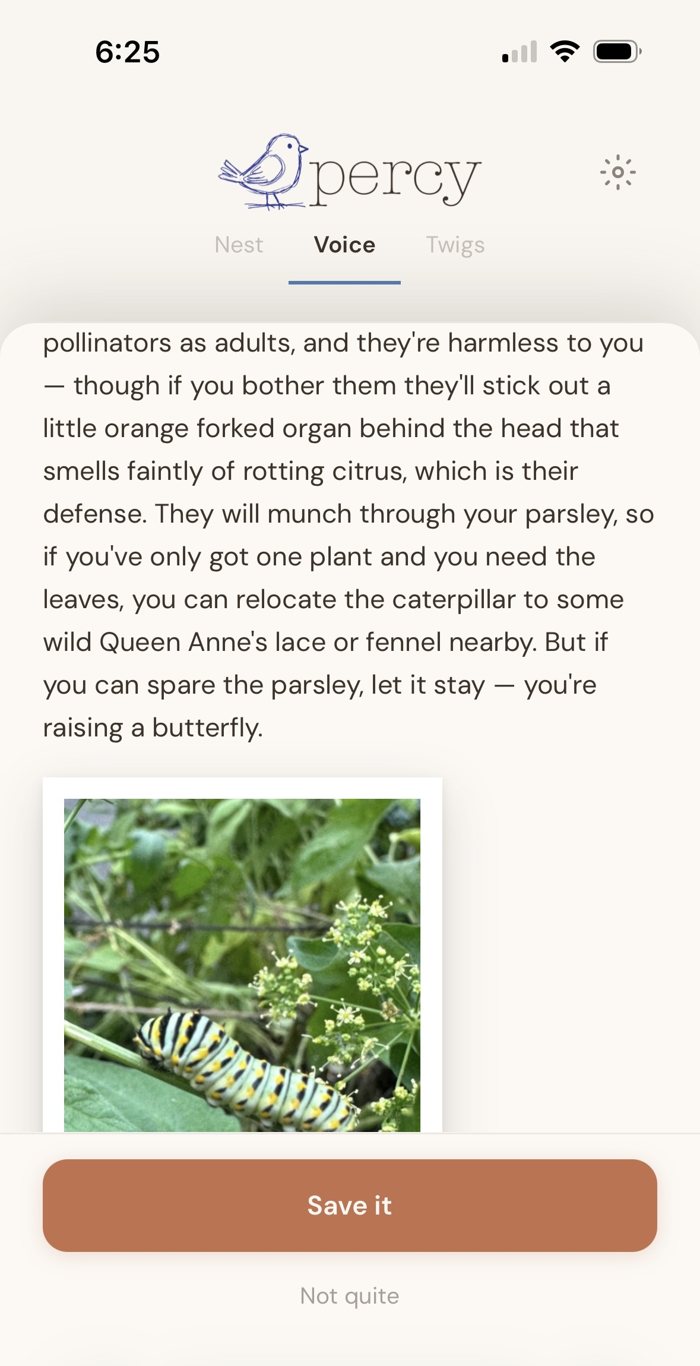
Take a photo and ask. Percy identifies plants, bugs, and plant diseases from a photo, and because it knows your garden, it tells you what they mean in context, not just what they're called.
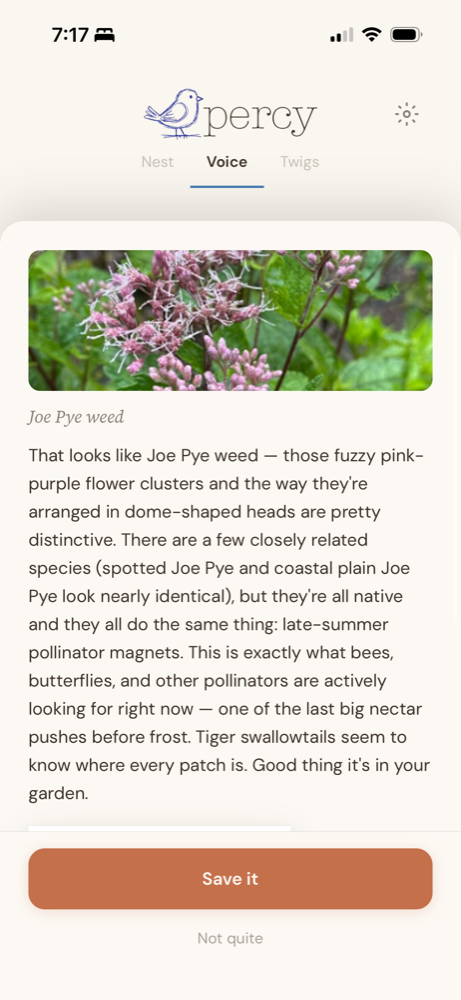
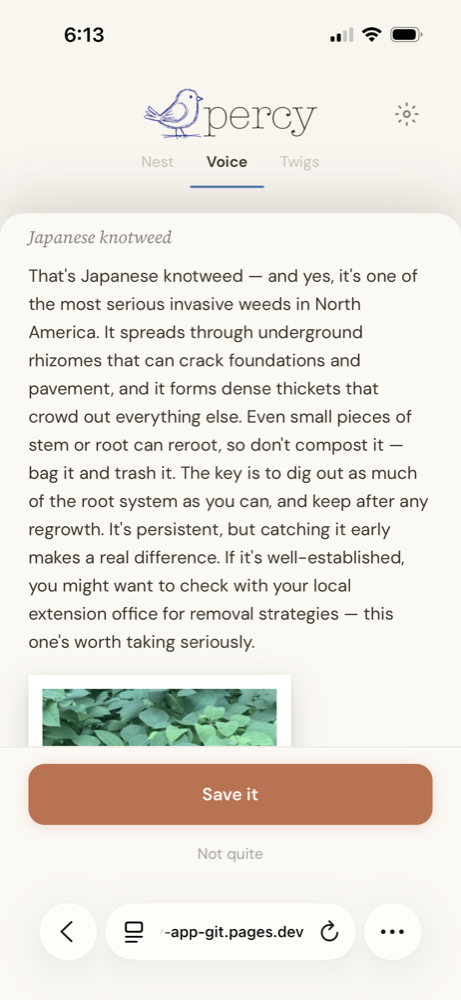
What is this plant? A weed? A volunteer tomato from last year? Something you started from seed in April and completely forgot about by later in April? (Not that any of us have done that.) Percy will tell you what it is and what it means for your garden: whether it's a native worth keeping, an invasive worth pulling, or something toxic to pets that needs to go immediately.
Friend or foe? Got a bug you didn't invite? Percy will tell you what it is and what to do about it. It'll also tell you if the thing you're about to spray is a beneficial insect doing your pest control for free, which happens more often than you'd think and is an extremely efficient way to fire your best employee.
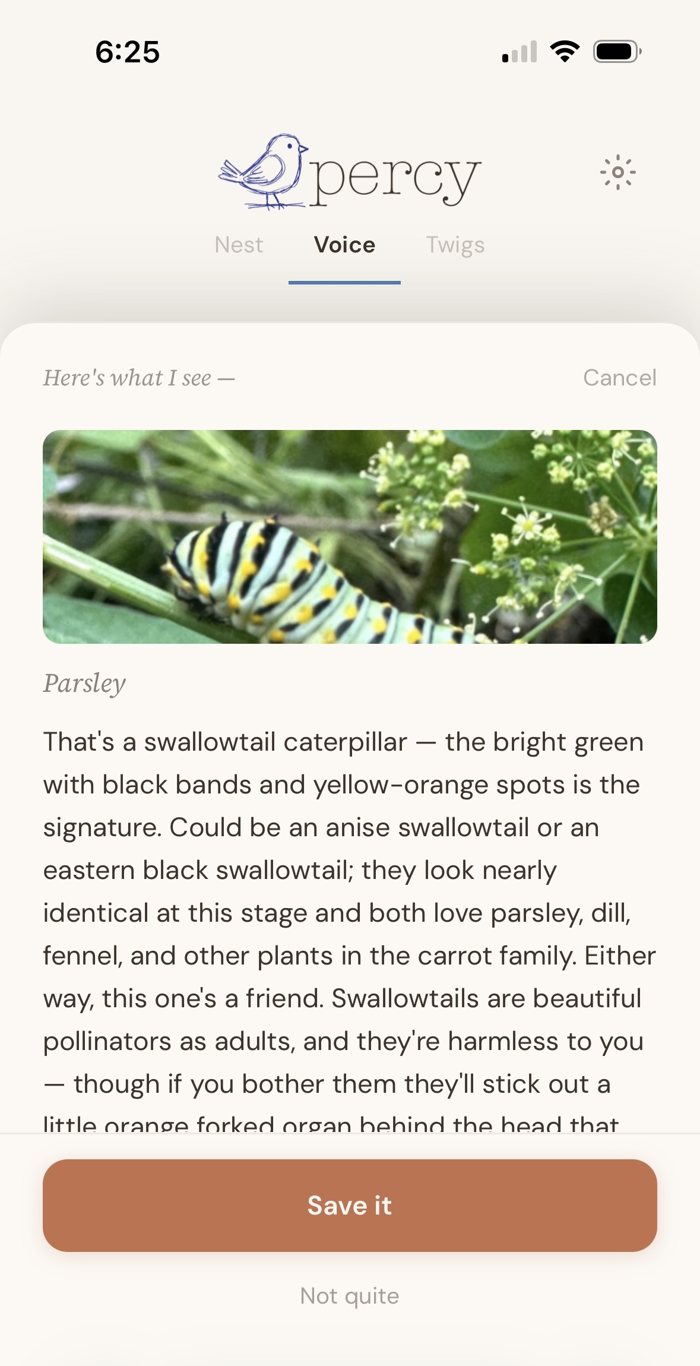
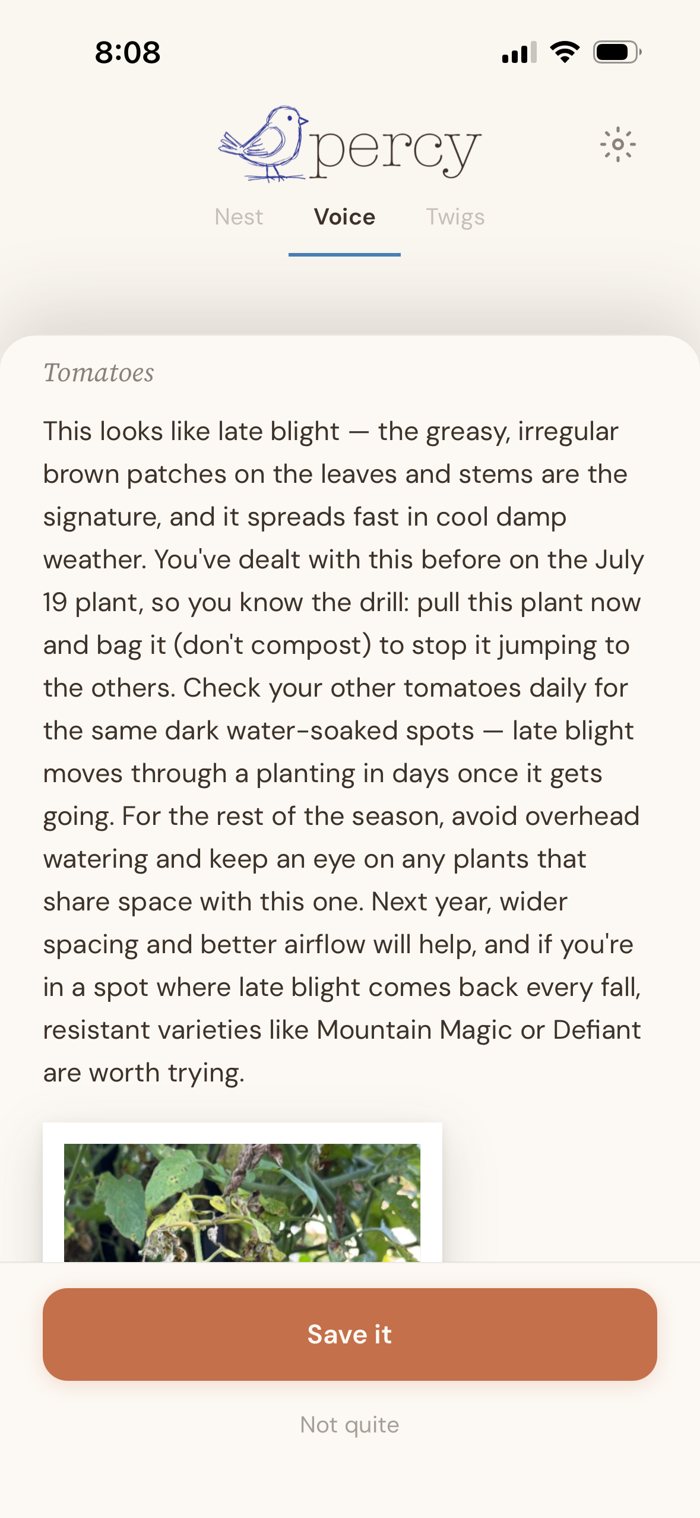
What's wrong with my plant? Share a photo of the yellowing leaf, the wonky stem, the flower that looks like it's having a very bad week. Percy will help you work out what might be wrong and suggest a next step.
Native, invasive, or good for pollinators? Percy can tell you whether a plant is native where you garden, potentially invasive, valuable to pollinators, or otherwise important to the ecology of your garden. When it isn't sure, it says so.
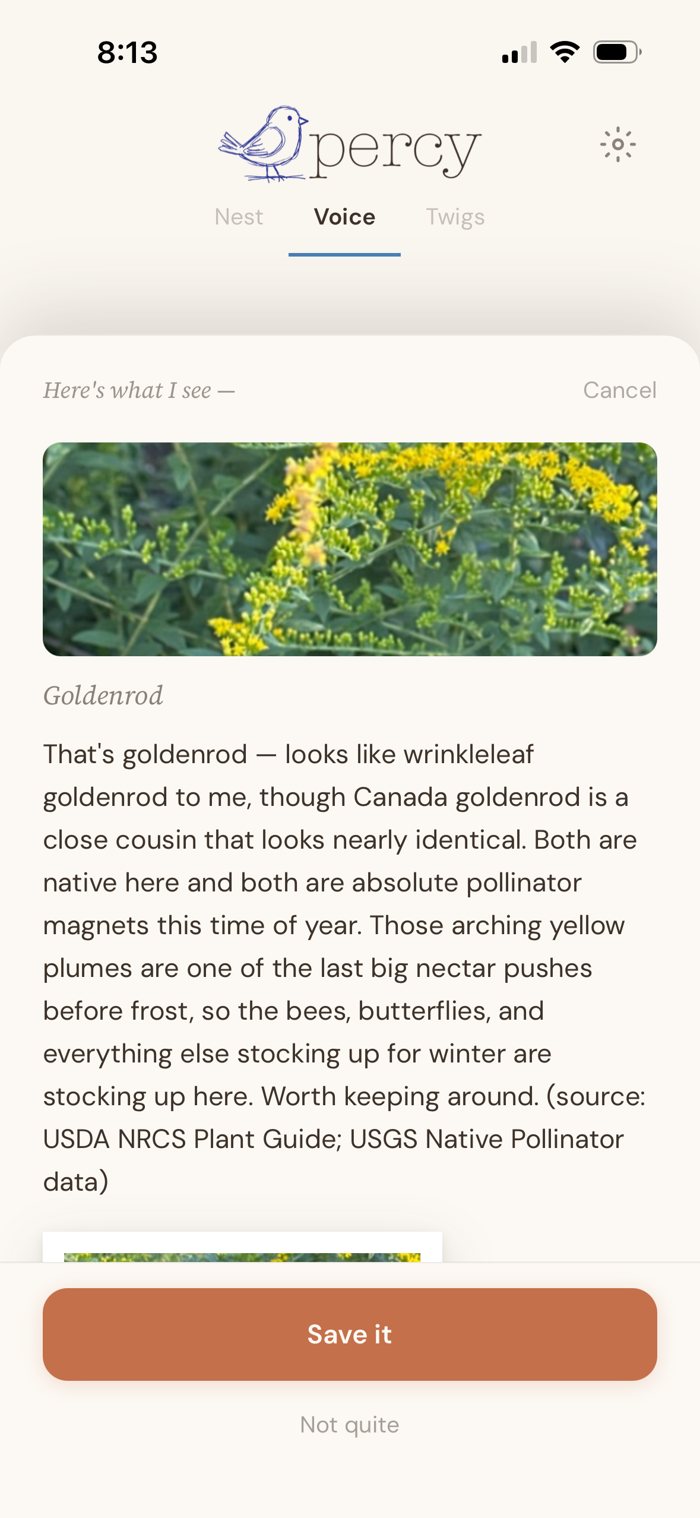
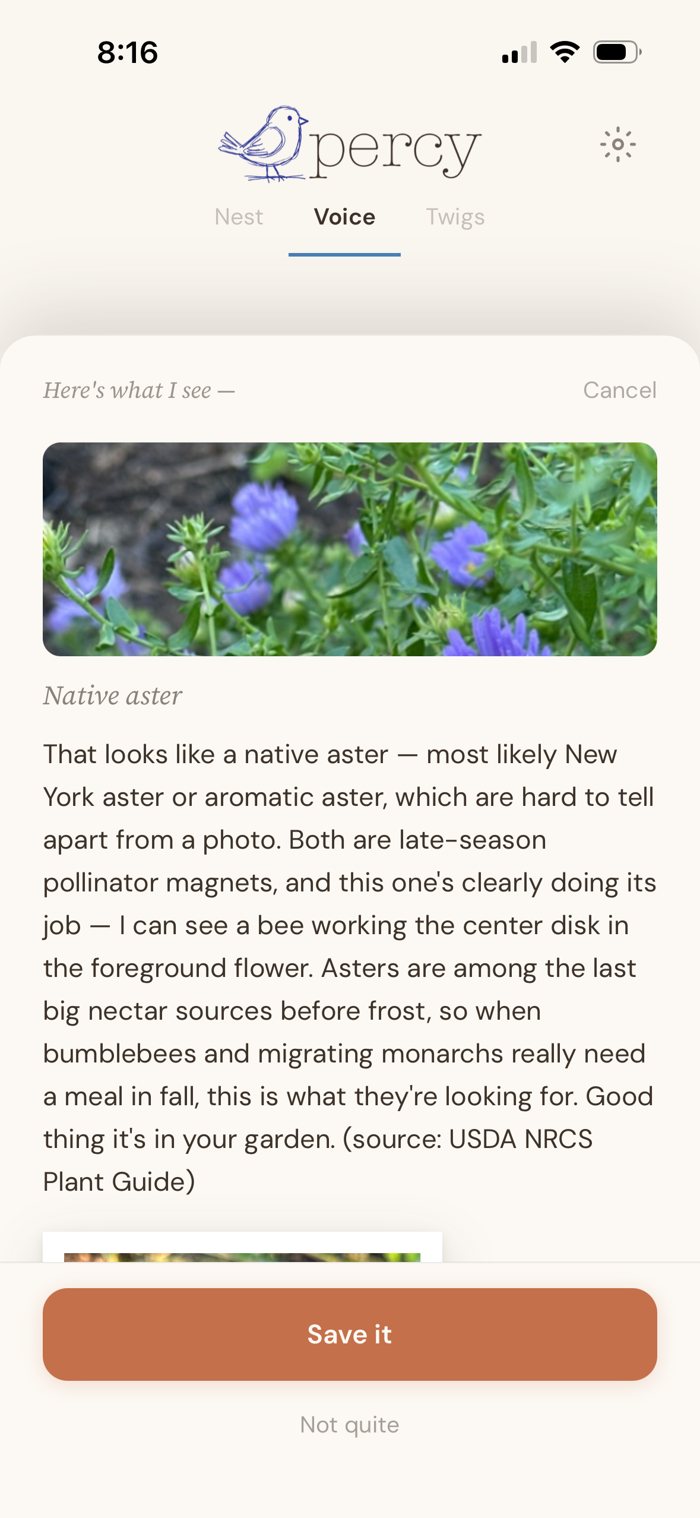
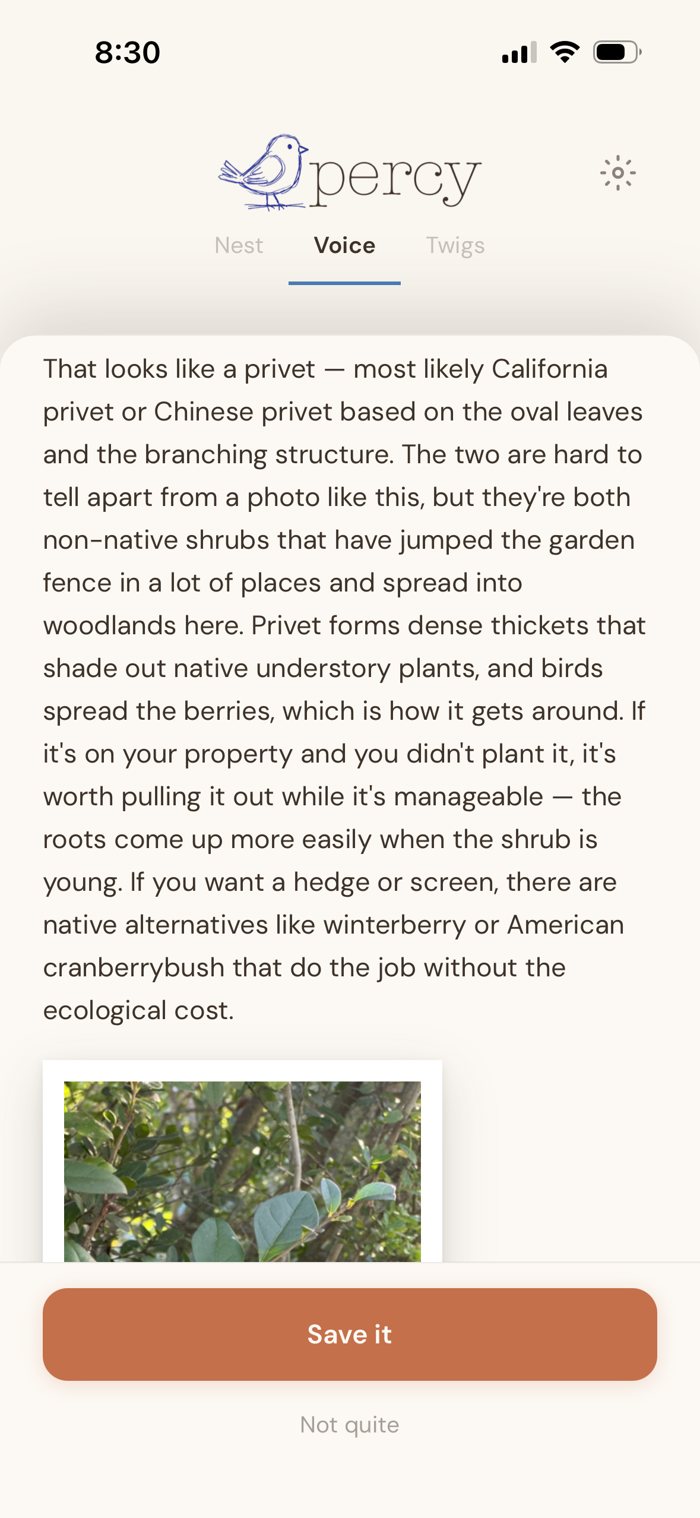
When you identify something new, tap Save it and it goes into your Nest. The more Percy knows about what's moving through your garden, the better it gets at catching patterns.
6. Capture the moments and the people, not just the plants
"It's been raining for two weeks and I'm starting to worry about the tomatoes." "I finally weeded the back bed. I cannot explain the satisfaction." "Everything looks beautiful today. I just wanted to say that."
These feel small in the moment. They aren't events, exactly. Nothing was planted or harvested or identified. But they're the texture of a season, and Percy keeps them. When Percy builds your Migration Report, these are what give it an emotional arc instead of just a timeline.
The same goes for the people. As lovely as your plants are, don't only photograph plants. If you have kids, capture them helping with the harvest, finding an especially wiggly worm, or chasing butterflies. Take a selfie with your coffee during the early-morning garden inspection, before anyone in the world has had a chance to ask you for anything. A group shot at a harvest party. Your dog finding the perfect patch of shade, right in the middle of the strawberries.
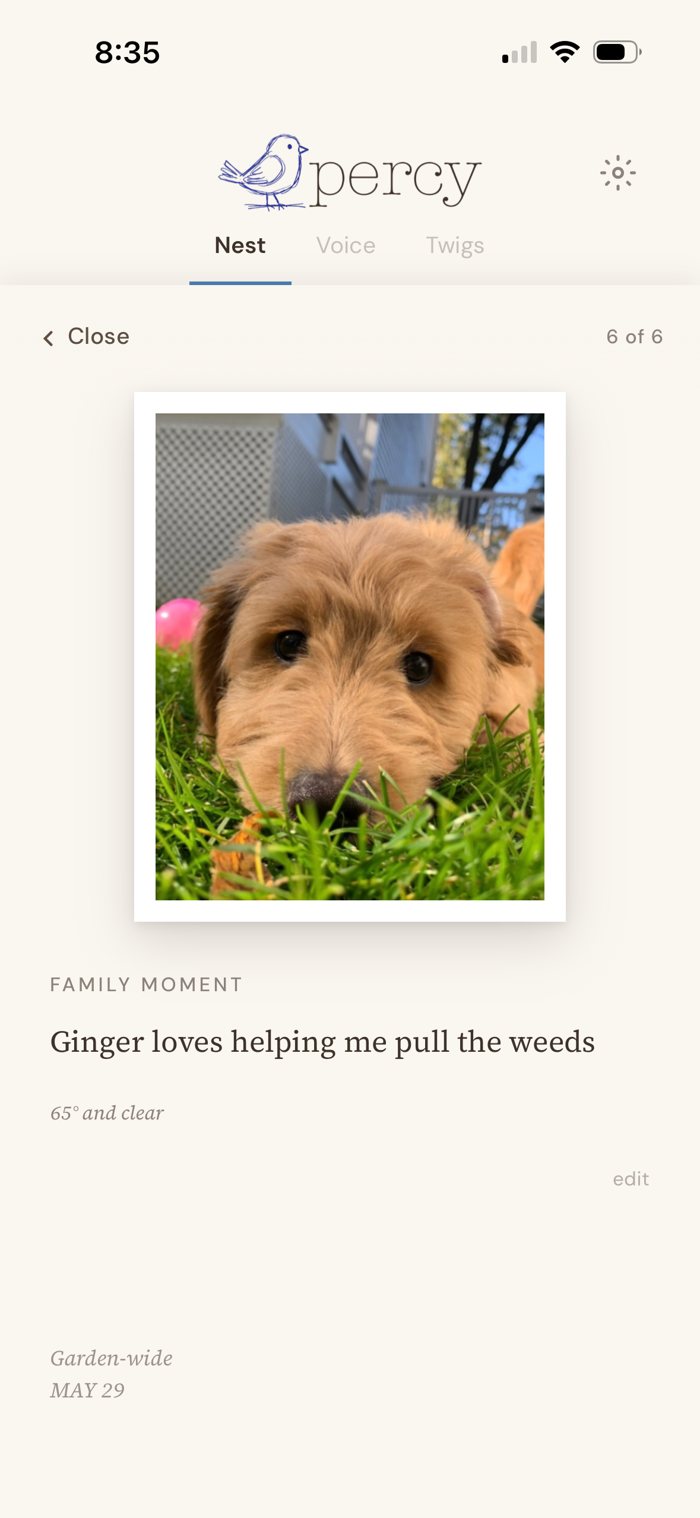
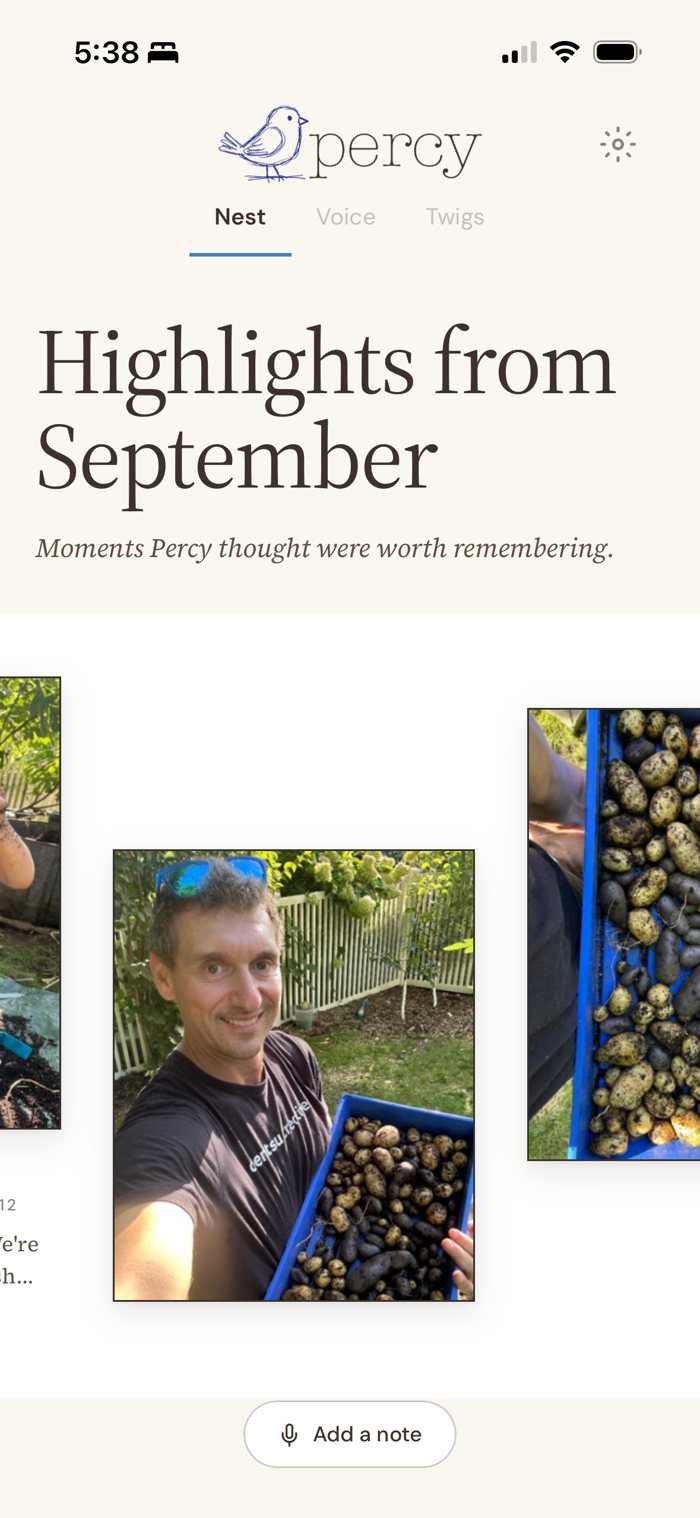
Don't edit yourself. If it felt worth noticing, take the photo and tell Percy what was happening.
7. Track weather, frost, and growing conditions
Add your location on the account page and Percy tracks weather conditions automatically. Every observation is timestamped with the conditions at that moment (temperature, humidity, precipitation), so you can look back later and understand not just what happened, but what was happening around it.
If a frost is coming, or a heat wave, or a long dry stretch, Percy will flag it right above the talk button before it arrives.
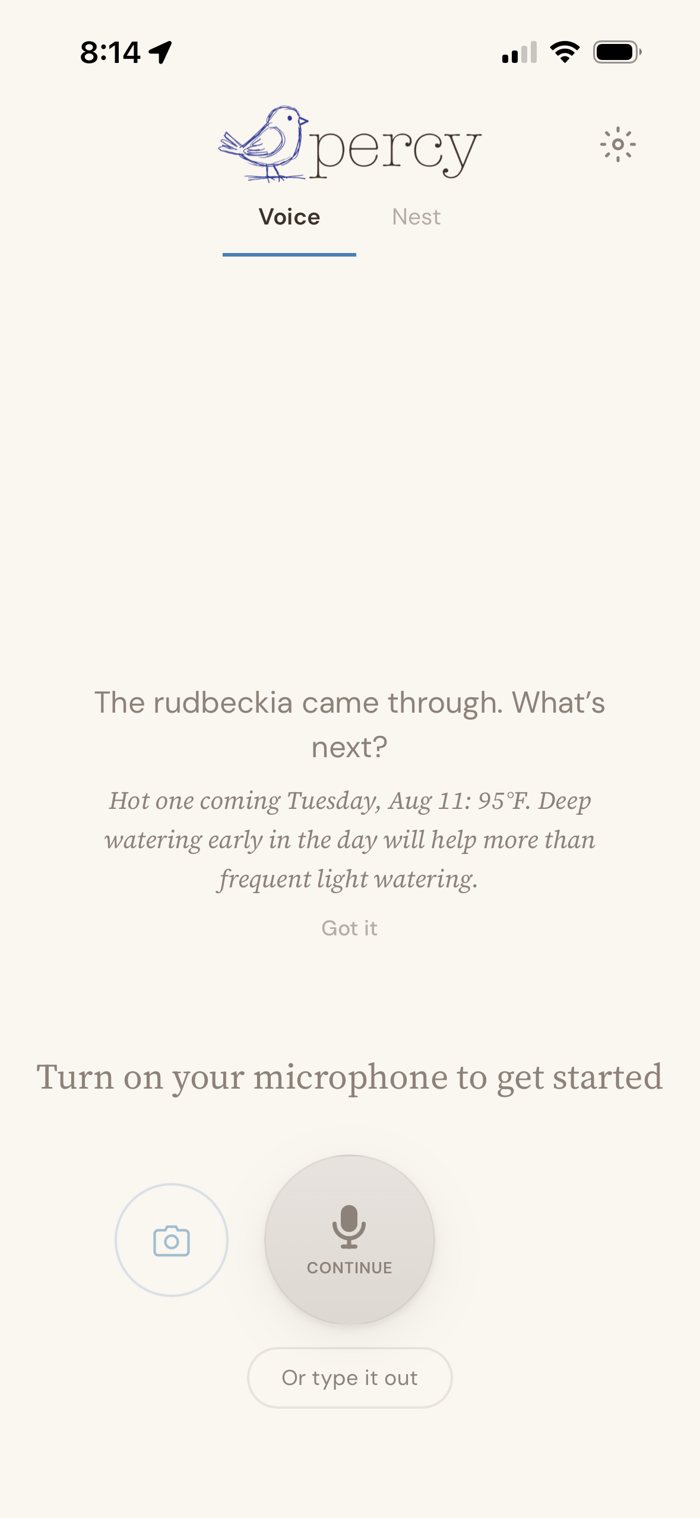
Because the weather is attached to your observations, Percy can help connect how your plants did with temperature, rain, humidity, frost, and the season. So you can ask: "What was the weather like when the roses bloomed?" "Was it dry when the beets bolted?" "When did we get that cold snap in May?" Percy knows. It's been keeping notes.
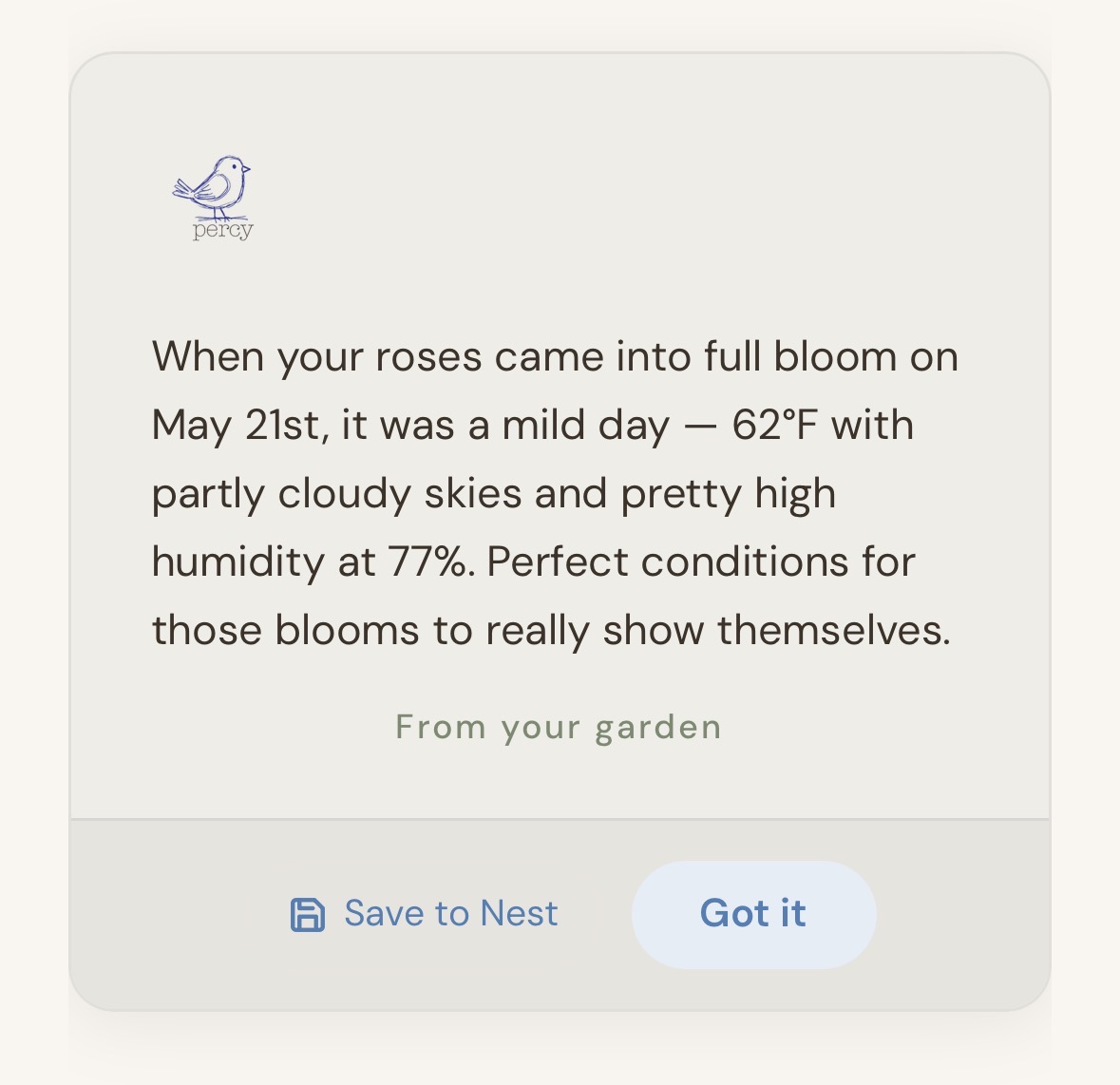
By your second season, you'll have something most gardeners never get: a weather-tagged history of your own garden. The kind of thing that turns guesses into patterns.
8. Set garden reminders and recurring tasks with Tending
The things you mean to do in the garden have a way of disappearing, or of ending up in a notes-app grocery list between "bananas" and "yogurt." Percy makes it easy to keep track of them.
Tell Percy whatever's on your list, however it comes out. "I need to prune the roses this weekend." "Have to order mulch." "Remind me to fertilize the figs every two weeks." Percy understands all of it and adds it to Tending, a running task list in the Twigs tab. You can add to it, edit it, and check things off as you go. If you mentioned a date or timing, you'll see it organized for you, and recurring chores repeat on their own.
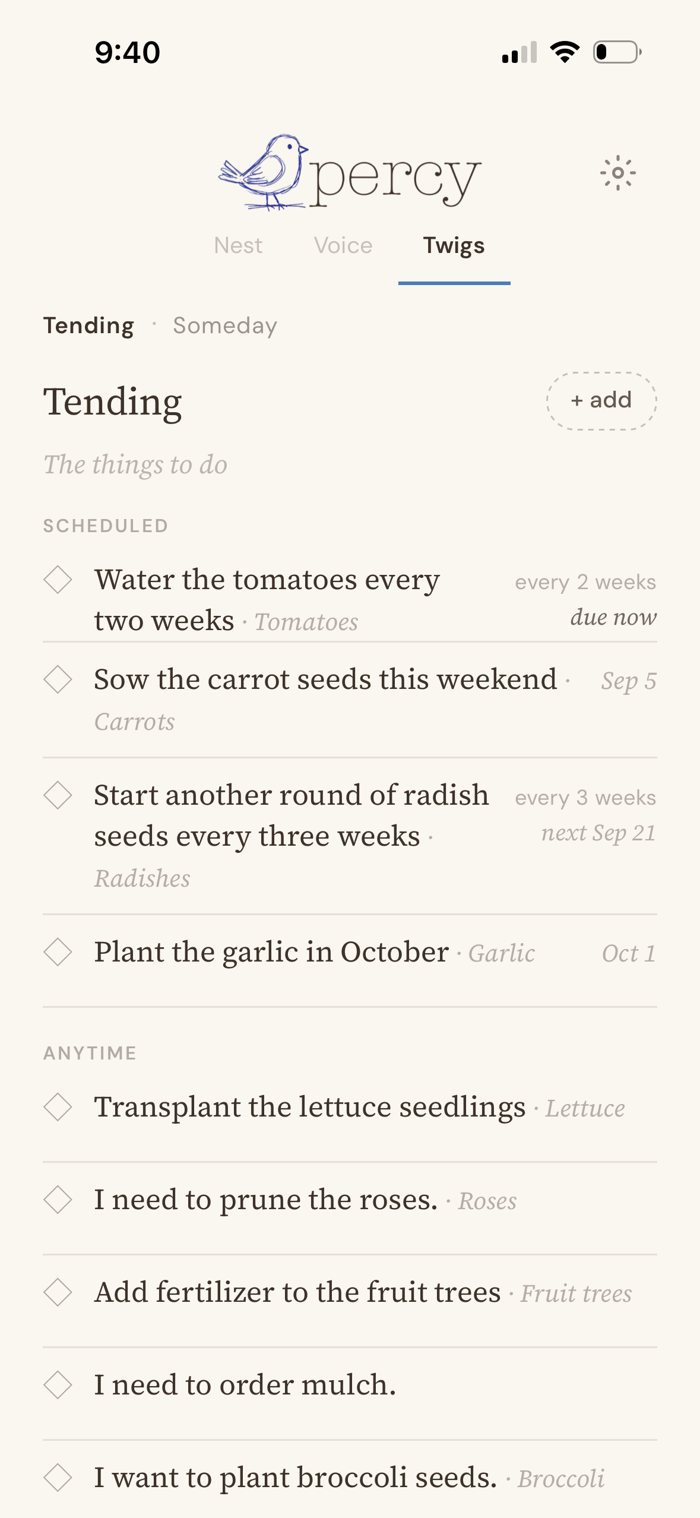
One important thing: this is not a productivity app. There's no Inbox Zero, no little red warning icons, no notifications making you feel like you're failing at life because of the unpurchased mulch. It's just a place where the things you mean to do don't get lost.
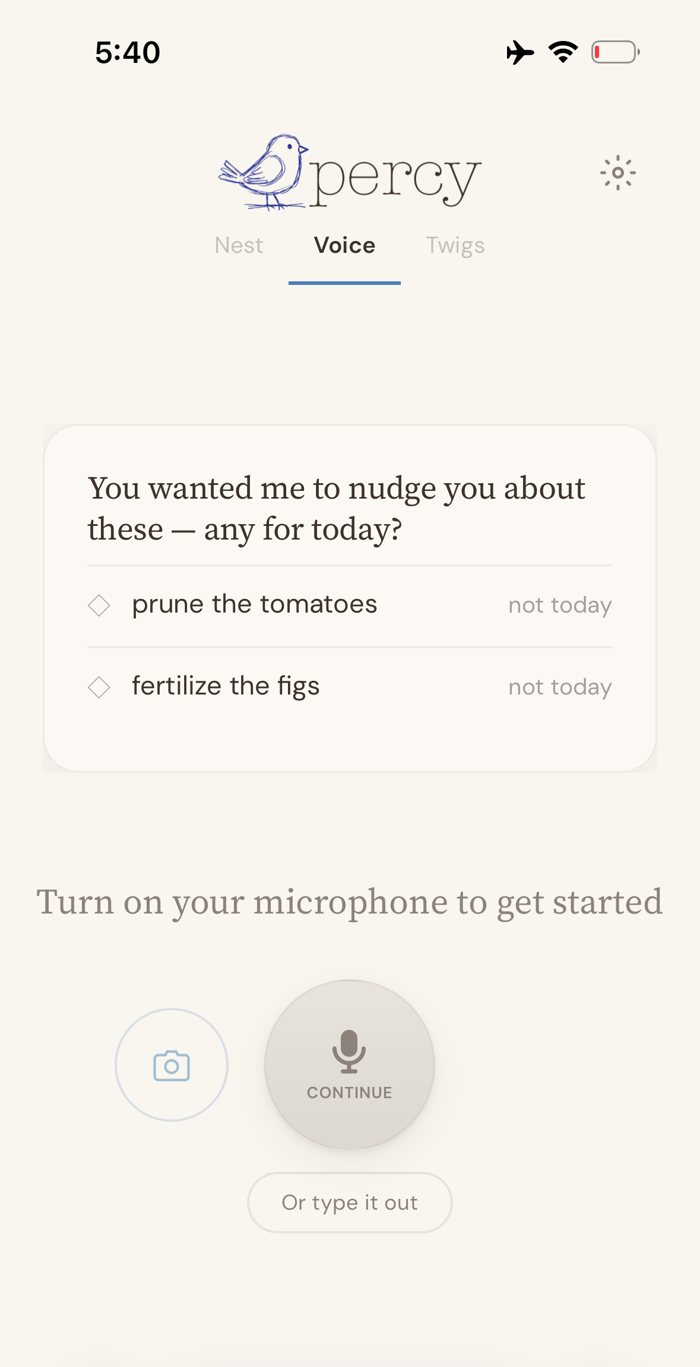
(Push notifications and calendar integration are coming. When they're ready, they'll be completely optional, and they will never nag you the way a certain owl nags you about your Spanish lessons.)
9. Save garden inspiration and ideas with Someday
Every gardener has a version of this: a photo on their phone of a window box they walked past. A screenshot of a trellis at a French café. A vague but powerful conviction that there will, eventually, be a greenhouse.
Someday is where all of that goes. It's a searchable garden mood board for plants, photos, design ideas, and things you might want to try later.
Share a photo from your camera or your photo library, or just say the thing out loud: "Someday I'd love a greenhouse." "I want to try 'Queeny Lime' zinnias next year." "I need a trellis exactly like the one at that café in Provence." Percy saves it to a visual mood board in the Twigs tab. It may even assume you've been to Provence and think you're very worldly.
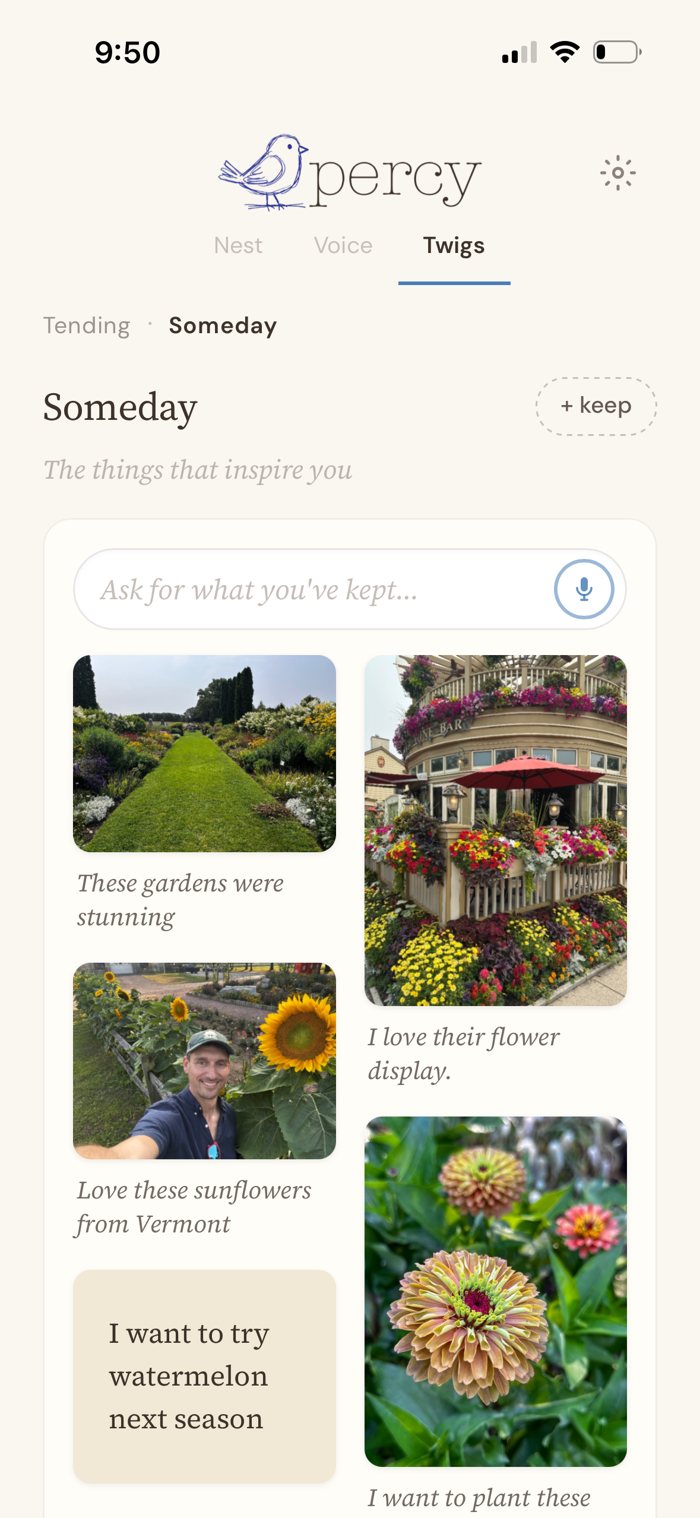
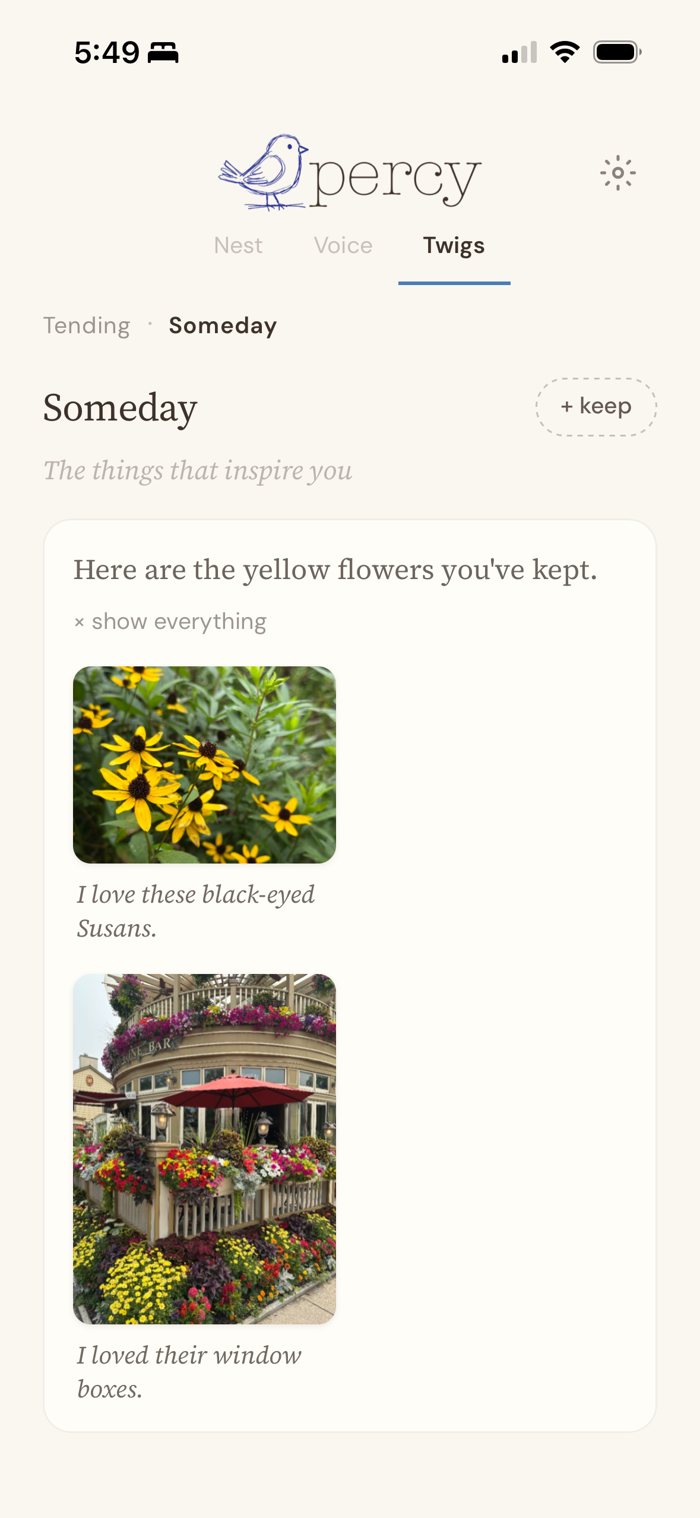
The useful part is that it's searchable. Ask Percy to show you all the purple flowers you've saved, or every trellis idea, or everything you've been meaning to do with the back bed, and it pulls up a grid of exactly that. No scrolling back through your camera roll trying to remember what that thing was or why you saved it.
Someday is for the garden you're slowly building toward. The one that exists right now only in photos and half-formed ideas, and a greenhouse that is, admittedly, probably a few years out.
10. Build your end-of-season Migration Report
Everything you share with Percy builds toward the Migration Report you'll get at the end of the season. It's a record of your year, and more than that, a portrait of what it was like to grow it.
So think about what you'd want it to include. The harvests and the losses, yes. But also the people who were out there with you. The things that surprised you. The mornings. The evening cocktail you drank while admiring your handiwork. The photo of the dahlias you took before anyone else was awake.
Percy keeps all of it. Come January, it gives it back.

Frequently asked questions
What is Percy? Percy is the gardening app that remembers your garden: a journal, planner, and personalized assistant you just talk to. Tell it what you planted, noticed, picked, or lost, and Percy files it, tags it with the weather at that moment, and builds a searchable record of your garden. At the end of the season, it turns that record into a Migration Report.
Is Percy a garden journal or a garden planner? Primarily a journal: a record of what actually happened in your garden, kept by talking instead of filling out forms. It also handles light planning. Tell it what you mean to do and it holds those tasks and ideas in the Twigs tab.
Is Percy a garden tracker? Yes, one you never have to update. Percy tracks your plantings, harvests, photos, pests, weather, and reminders, but there's nothing to fill in. You just talk about your garden, and Percy keeps the record.
What is the Nest? The Nest is where your garden's history lives: everything you've observed, grown, and photographed. Every plant you mention gets its own chapter, with its notes and photos in one place.
What are Twigs, Tending, and Someday? Twigs is the tab for what comes next. Inside it, Tending is your list of garden tasks and reminders, and Someday is a searchable mood board for ideas and inspiration.
What is a Migration Report? The Migration Report is what Percy builds at the end of your season from everything you've shared: the harvests and the losses, the weather, the people, and the small moments. The more you tell Percy during the season, the richer the report.
Can Percy identify plants and pests? Yes. Take a photo and ask. Percy identifies plants, bugs, and plant diseases, and tells you what they mean for your garden: whether a plant is a native worth keeping or an invasive worth pulling, whether a bug is a pest or a beneficial insect, and what a yellowing leaf might mean.
Can Percy tell me whether a plant is native or invasive? Yes. Percy can tell you whether a plant is native where you garden, potentially invasive, or valuable to pollinators. That depends on location, since the same plant can be native in one region and a problem in another. When Percy isn't sure, it says so rather than guessing.
Does Percy give personalized gardening advice? Yes. Percy knows your location, your plants, and your beds, so its answers are based on your garden rather than general advice for your zone. Ask whether it's too early to plant something, how much sun a spot gets, or why the beets bolted. Its advice leans organic-first, and it improves as your history grows.
Can Percy remind me when to do garden tasks? Yes. Say "remind me to order mulch" or "prune the roses this weekend," and Percy adds it to Tending, a running task list in the Twigs tab. There are no overdue warnings or red badges.
Can Percy track recurring garden chores? Yes. Say something like "fertilize the figs every two weeks" or "check the tomatoes for hornworms every few days," and Percy keeps it as a recurring item in Tending. You can edit it or check it off as you go.
Does Percy track weather? Yes, automatically. Every observation is tagged with the temperature, humidity, and precipitation at that moment, and Percy keeps a daily weather log for your garden, including rainfall. You can ask questions like "was it dry when the beets bolted?"
Does Percy know my USDA growing zone and frost dates? Yes. Add your location on the account page and Percy works from your growing zone, your local frost timing, and your nearest weather station. It can tell you whether it's too early to plant something and warn you before a frost or cold snap.
Can I use Percy for vegetable gardening? Yes. Log what you plant, follow it from seedling to harvest, record what you picked and what you did with it, and ask Percy about your specific crops. By your second season you'll have a weather-tagged history of which varieties were worth growing again.
What if I don't know what to say? Say what's happening right now, the way you'd answer a friend who asked how the garden's doing. "I just planted the tomatoes." "The garden looks happy after all that rain." "The cat pooped in the grow bag again." Each of those is a complete observation. Percy handles the organizing. (Sorry about the grow bag.)
Do I have to use Percy every day? No. There's no streak to keep and no right cadence. Use it when something feels worth capturing. Even 20 or 30 observations across a season gives you a searchable, weather-tagged record of what you grew, what worked, and what your patch of ground did that year, and it's enough for a real Migration Report.
Is Percy free? Free for your first full growing season, with no credit card required. After that, it's $39 a year as a Founding Member, locked in for as long as you stay subscribed. Get started at percy.garden.
Is my garden data private? Yes. Your garden record is private to your account, and Percy does not use your notes or photos to train AI models. Our privacy policy commits to that, for us and for the AI providers we use. You can delete your data at any time. See our privacy policy for details.
Written by Brian Eden, creator of Percy, who built it because he wanted somewhere to keep the parts of a season that never made it into a notebook.