What a Plant App Owes the World
Brian Eden
When we moved into our home, there was a large privacy hedge that ran the length of the front yard. It was 8 feet tall, but invisible to me. It was green wallpaper that I never even noticed except for when the ball rolled under it.
But a few years later, after listening to a podcast interview (the Joe Gardener show) with a guy named Doug Tallamy, I discovered that this particular bush was called privet. And it was bad. (I also didn't know a bush could be bad.)
It turns out I was unknowingly harboring an invasive plant. One that spreads aggressively when birds eat the berries and deposit them elsewhere. When it re-seeds, it crowds out native plants and damages entire ecosystems that depend on them for survival.
I was understandably distressed to discover that my hedge was a real jerk.
It made me curious what other bad actors might be lurking around the edges of my yard. I downloaded an app (Seek by iNaturalist) and started asking every plant to show some ID. Little did I know how many unsavory characters had been taking advantage of my naivete to allow their continued attempts at world domination. Here was multiflora rose and tree of heaven. There was English ivy and Norway Maple.
Walking the dog around the nearby nature preserve, app in hand, I felt a bit like a superhero who just discovered I had X-Ray vision. A whole world of information opened up that was completely invisible to me. I'd walked by these plants daily for years and just thought it was nice nature doing its naturey thing. I didn't realize how much of that nature was actually bad guys worth fighting.
The leafy green carpet blanketing the ground turned out to be garlic mustard. The sweet-smelling Japanese honeysuckle whose childhood nostalgia factor masked the boa-constrictor-like damage it was doing to the small trees and shrubs that it was choking out. And there was one entire block-long-section of bushes that I discovered was Japanese Knotweed. One of the worst-of-the-worst and one of the hardest to eliminate.
This block of knotweed was a small microcosm of the damage invasive plants can do. It had created a sea of sameness. What's called a monoculture. Spreading so fast and aggressively that no other plants can compete for light, water or space.
It matters because all of those other plants that the invasives crowd out are the ones our wildlife depend on for food, shelter and survival. The native plants that these invasives had overtaken are the ones that support the diversity of birds, bees, bugs and the other small woodland creatures known for joining Snow White in musical interludes.
Without them, populations decline and entire species become endangered.
No more musical interludes. Yikes.
The whole thing started to make me see my role as a gardener differently. If I pulled out the bad invasives and replaced them with native plants, I could undo some of the harm. I could turn my little flower bed into something more than just beautiful landscaping. It could be a tiny, beautiful nature preserve.
Which is Doug Tallamy's whole thing. He founded Homegrown National Park on the belief that if all of us gardeners help pull out the invasives and plant things that help wildlife, the collective acres restored would far outweigh the National Park System.
It also made me realize something important about building Percy. Percy is a gardening journal that identifies plants and gives advice about them.
And that comes with a huge responsibility.
Because when a gardener asks to identify a plant or insect, the important answer is often not "what is this thing called." It's "does this thing belong here?" and "what do I do about it?"
The answer changes depending on where you're standing.
The same plant that's an ecological hero in one location can be a dastardly villain in another. Take goldenrod. It's one of the most important plants you can add to a garden in Ohio for the local wildlife. The same plant in London needs to be pulled. Japanese knotweed is just another wild plant in Japan. It's an absolute wrecking ball nearly everywhere else.
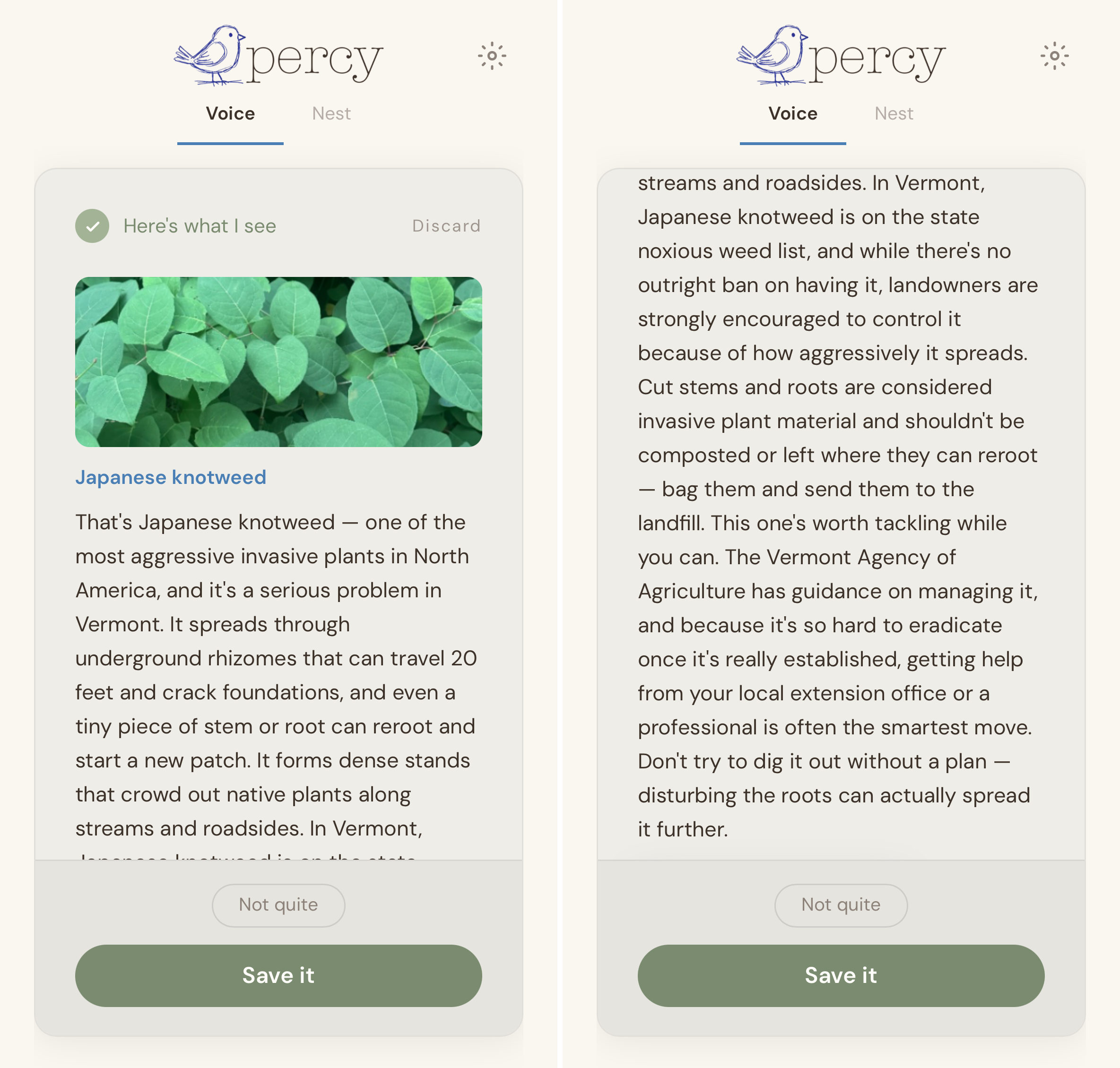
So for a plant identification app, ID-ing a plant is the easy part. Knowing whether it belongs where you live, and what it means for your garden, is the part that matters.
Because that's the part that decides what happens next. Should you nurture it? Plant more of it? Share a cutting with your neighbor? Or declare war against it?
The right advice, and the wrong advice, land at that same humbling, Tallamy-level scale. That's the responsibility I built Percy around.
So Percy — a gardening journal built around ecological stewardship — celebrates the natives worth keeping, flags the invasives worth pulling, and won't talk you into planting a wrecking ball.
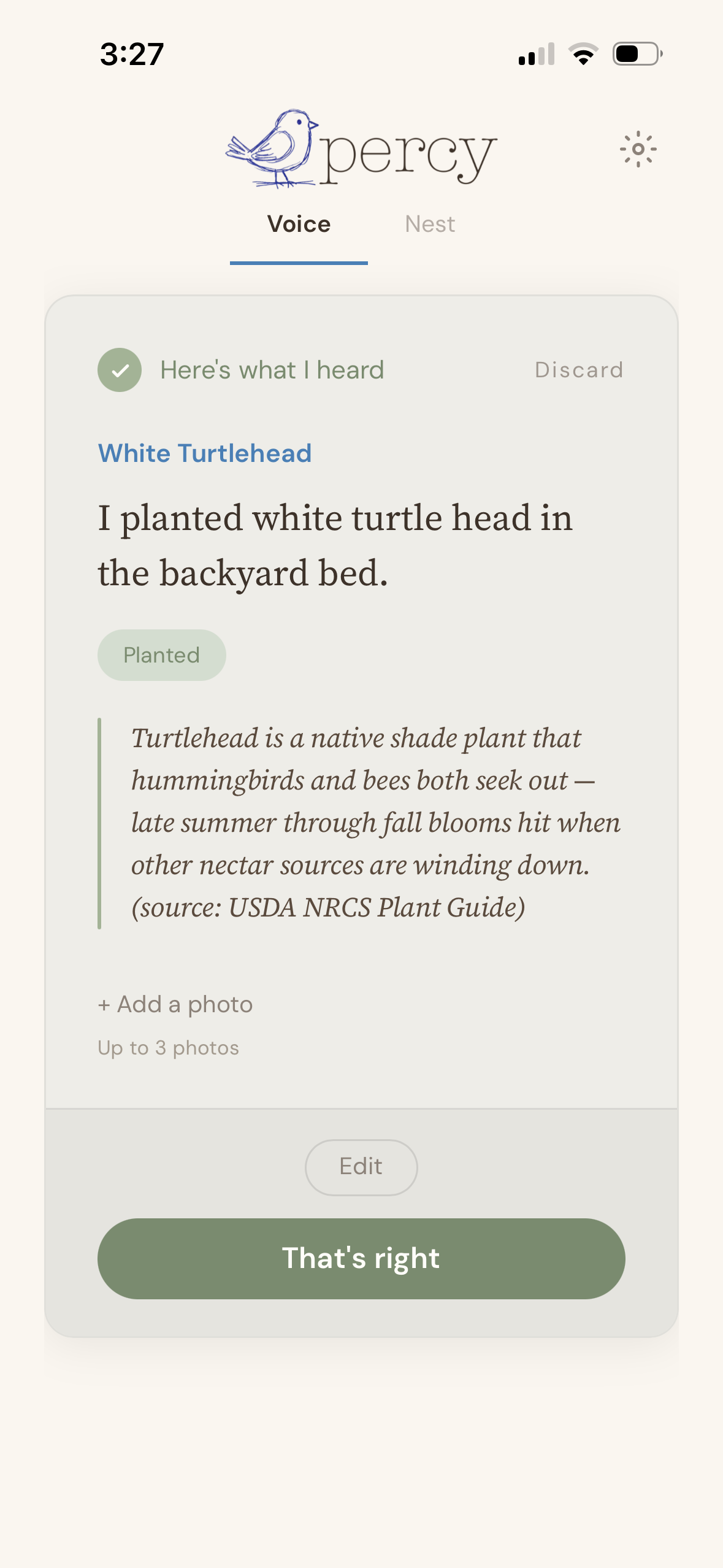
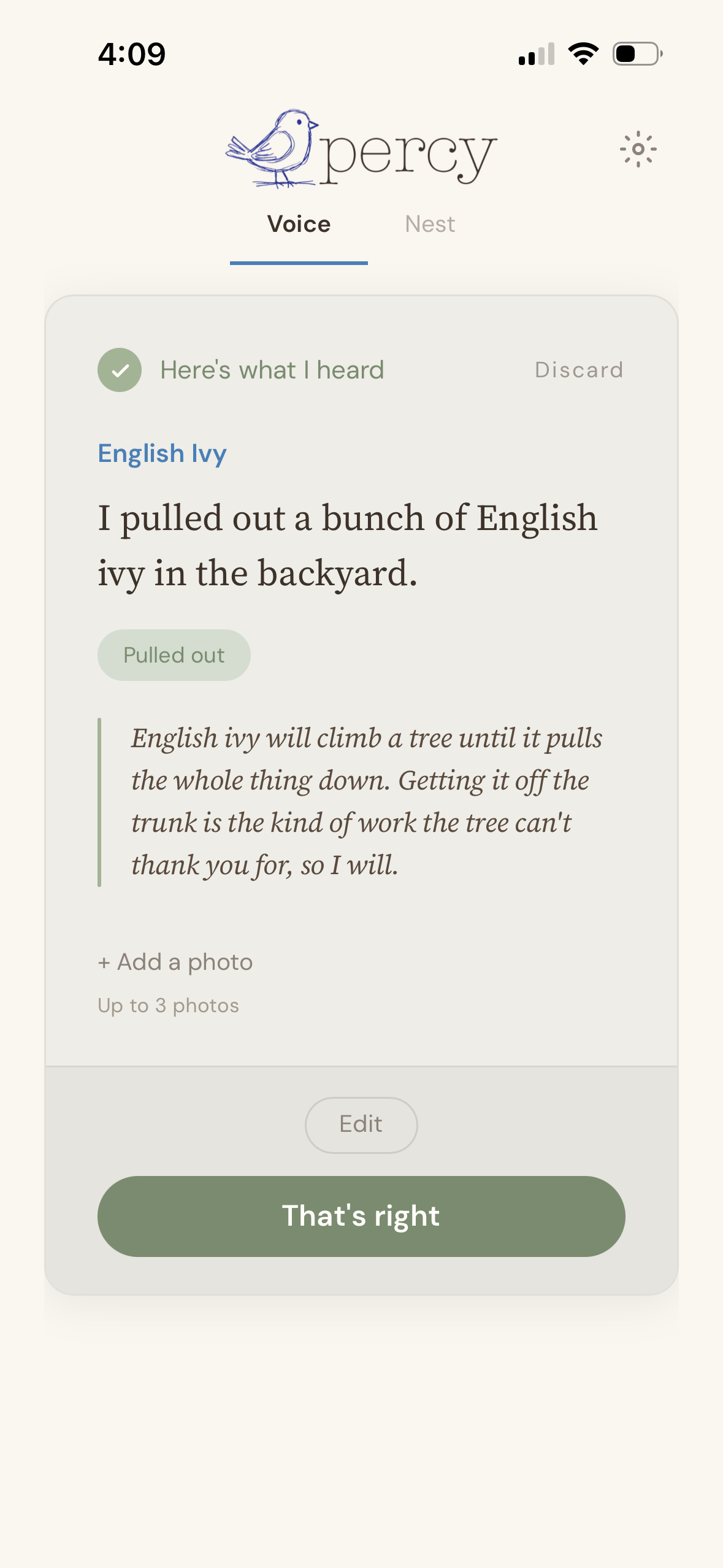
But the part I'm proudest of is what it does when it doesn't know. When a photo's ambiguous, or it doesn't have good data for your region, Percy says "looks like…" or "I'm not sure," or stops at identification without including guidance. Because confident wrong advice is worse than none at all. It's how you end up planting the next 8-foot-tall privet without realizing it. Percy does its best from a photo, but it'll tell you straight: there's no substitute for kneeling down and looking.
And when something does need spraying, it points you to the organic way first.
That's what a plant app owes the world. Because at scale, it can do incredible good. Not just sharing what plants are called but what they can do to help.
I built Percy to give everyone that X-ray vision superpower instantly. The vision and understanding that it took me years of naive dog walks and an enlightening podcast to earn.
And the ability to look at that privet hedge, call in a backhoe and put an end to its plans of world domination.
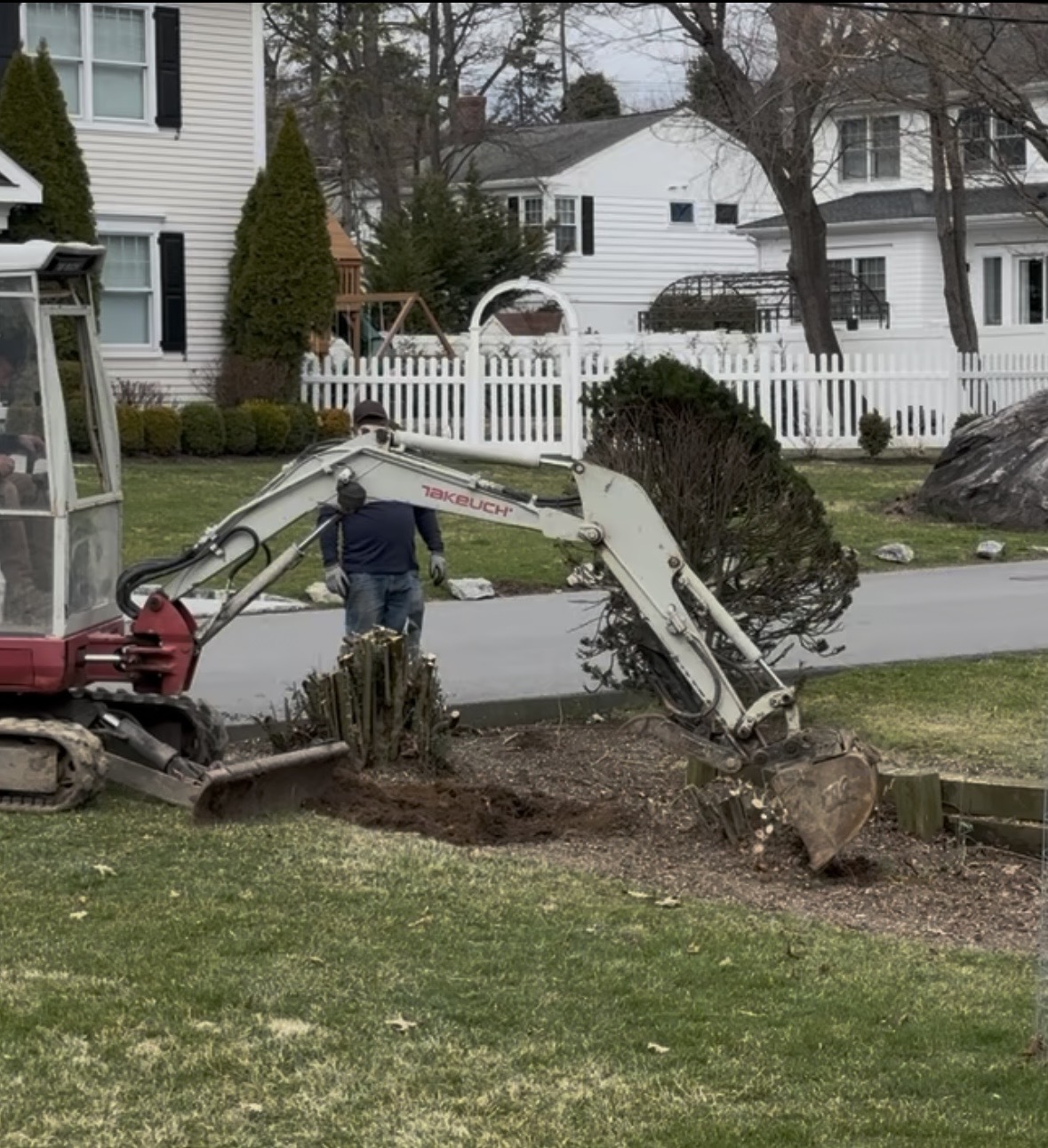
I replaced it with a pollinator garden.
Percy is a gardening journal that identifies your plants and helps you tell the natives worth keeping from the invasives worth pulling — and it's honest with you when it isn't sure. Start your free season.